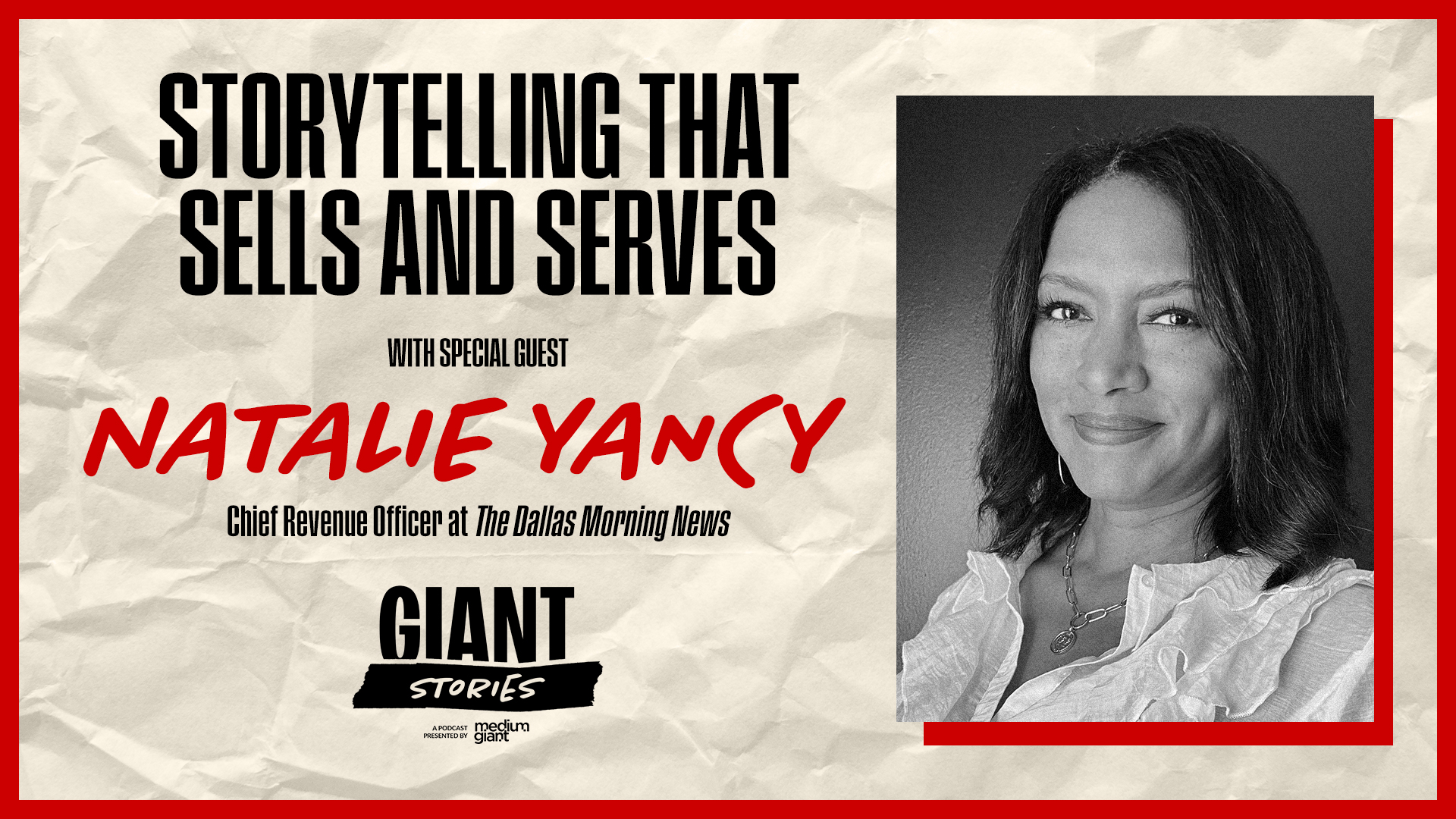
Episode 15 Transcript
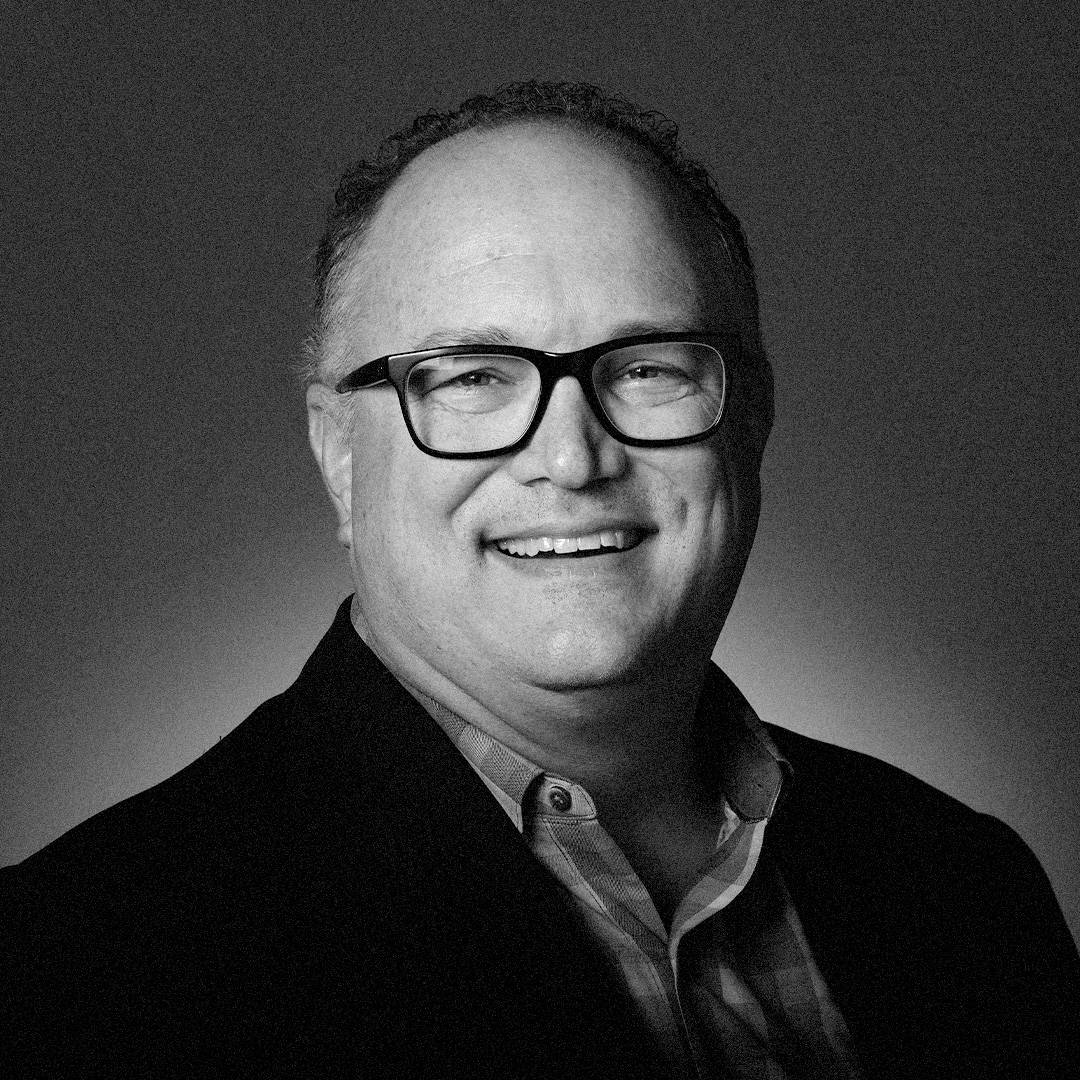
John Kiker: [00:00:00] Welcome to Giant Stories, a podcast inspired by people and brands with meaningful stories to share. I’m John Kiker, your host and president of Medium Giant, a fully integrated creative marketing agency in Dallas and Tulsa. While the tools we have at our disposal to create and share stories have never been more broad and varied, the fundamentals of great storytelling remain as transcendent as ever.
Despite the headwinds our industry faces, clients and brands will always covet companies that remain steadfast with a steady eye on culture and understanding of the business dynamics at hand and com, and a commitment to the fundamentals of what makes a great story. So today I’m excited to have Natalie Yancy, my colleague and chief revenue officer, The Dallas Morning News.
Natalie’s remit around storytelling for this company is unique in that she uses the platform of the Dallas Morning News’s ecosystem to help clients tell their stories, but she also manages the team charged with creating content for the morning news itself, such as our four DFW programs and abode. I.
Which is our real estate hub. To say her role in storytelling for our organization is critical, will be a significant understatement. So as a native [00:01:00] Dallas site, Natalie’s resume extends far beyond her extensive time with the morning news, having worked with the Dallas Business Journal and Douglas Media among others.
But beyond her day job, she deeply invests herself in the in our community. Whether that’s being on the board of directors for Dallas Morning News charities, working with Clyde Warren Park, the Richardson Independent School District, or even the Dallas Regional Chamber. She’s also gonna be honored later this week by the American Advertising Federation’s.
Dallas Chapter is an A A F luminary, which recognizes women in our ad and marketing community who blaze new trails, empower everyone around them and inspire the next generation with outstanding talent, leadership and innovation. I love that descriptor about you. Thank you. I think it’s, I don’t know who very apropos.
Okay. I got it off the website. So whoever wrote it, I think whoever
Natalie Yancy: wrote that did Outstanding. Yeah. Yeah,
John Kiker: my friend. Thanks for joining me. Thank you. Glad you’re here. Thanks for having me. Absolutely. Um, so as we always do in our, uh, podcast episodes, we like to start off, uh, our discussions by asking our guests to tell their story.
So the floor is yours.
Natalie Yancy: Yeah, so I’ll try to tell it briefly. [00:02:00] Um, story is, grew up here, love Dallas. Um, I interestingly was going to go into broadcast news and, uh, realized I hated being in front of a camera. And, um,
John Kiker: as we sit here on, in front of a camera, yes, I
Natalie Yancy: do hate that. Um, and I really prefer to be behind the camera.
And, um, a job was offered at Channel eight that was extremely like. Junior and I was like, well, you know, they’re not hiring in this market. I would’ve had to move, so let me just walk across the parking lot and see what’s happening at this place called the Dallas Morning News. And that’s how I began as a sales assistant.
I worked my way around all types of sales. Teams, um, became a sales manager, a sales director, um, left and did newspaper rep firm work for a while. Uh, really just learning more and more about how we are going to position brands across newspaper assets, whether it was print, digital [00:03:00] at the time, um, newspapers were just getting into web development.
Website presence. Um, but they were really heavy into events at the time. And so that’s something that I really, um, enjoyed selling around was events. Dallas Business Journal allowed me to really delve even deeper into that model. Um, I prefer to be more on the creation side of, um. Opportunity versus just selling opportunity.
Um, interestingly, I had no intention of going into business development, but what I realized even since grade school was that I had no problem talking to people. I enjoy people meeting new people. Um, and I never felt like I was selling, and I still don’t. I feel like I’m just having a conversation and I’m finding out what it is you’re trying to do, where are you trying to go and how we can help you get there.
John Kiker: So talk about. Your love for Dallas, obviously, you know, you’ve got family here, you’ve got family Tyson, but what is it about Dallas? What is the story of Dallas that keeps you [00:04:00] so intrigued with this market?
Natalie Yancy: Yeah, I think what I love the most about our city is that it’s ever evolving. I know some cities. It could say the same thing, but we are really ever evolving.
We are not one industry. We’re not a one trick pony. We have so many different types of businesses, so many types of restaurants and, and lifestyles that exist here. And our city could pretty much offer any flavor that you like. Um. Growing up, our city felt very, very small. Mm-hmm. Um, it was a, a city where you could run into people you knew at the grocery store very easily.
Yep. Um, and now as Dallas has grown, we still have these small pockets that make you feel that way. Yet we are now very metropolitan, even industrial in some areas. And, um, I just think it’s a city that everyone can fall into their own little home, their own little boat.
John Kiker: Yeah. I think was. You know, I didn’t grow up here, but I’ve been here for, for, for 25 years.
Mm-hmm. And, and [00:05:00] so even if you see the, the, the market’s growth, fastest growing market in the United States, um, somewhat organic, somewhat by design. You see these little neighborhood pockets pop up almost like a New York or a Chicago in very entrenched neighborhoods. Mm-hmm. Um, not necessarily, you know, divided by by ethnicities, but more by, um.
Almost phases of development. Mm-hmm. And then like, you know, whether it’s, okay now the Californians are coming in, okay, here comes everybody from the East coast or whatever businesses moving to Texas is driving that growth. But I think it’s really unique around, um, you know, if, if you look to Dallas probably 30 years ago, you might say oil and gas and maybe a little bit of tech with your E DSS tis of the world.
But it’s so much more broaden and diverse now
Natalie Yancy: For sure. I mean, what’s that mean? Everything from legal to data center to, I mean, we have such strong industries across so many different categories and I think. The other thing I would say I like about just, I would say Texas at this point, is just the pride.
The pride that we take in everything that we do, the pride that we take in, how we overcome the pride that we take in winning, you know, well sometimes for the Cowboys, but the pride we [00:06:00] take, it’s been a hot minute, it’s been a minute, but the pride that we just take, um, in our state and in our, in our city, we are very.
Um, excited to represent our state on the big stage.
John Kiker: Absolutely. So talk about, um, you know, you being, uh, in this business as print started evolving into digital talk about what this, what the, what the storytelling. I. Options were in print. I mean, obviously you, you, you, you’ve, you’ve got a hard copy. But I, I think that people sometimes don’t give enough credit to the power of print and the stories that they can tell.
Right. So talk about that evolution into digital, but mostly like, because I know it’s, it’s funny when you and I have conversations around our business and how it’s evolving, it’s almost like people overlook the power of print sometimes. For sure. So we’ll focus on storytelling with print first.
Natalie Yancy: Yeah. It’s interesting too, that many brands.
Refuse to leave print because they know the effectiveness. They also know the differentiation of what that delivers versus other, other traditional media. Um, I would say the power of print is a, obviously it’s [00:07:00] tangible. It’s, it’s something that people can hold, feel, touch, and, uh, similar to magazine or anything else that you can hold to consume,
John Kiker: right?
Natalie Yancy: It immediately. Puts that into a different level of engagement. You’re holding it like a book or anything else that you, that you actually have to hold to, to digest. And so I think, you know, beginning with probably one of my first print Loves, which was like Highlights magazine. Okay. I don’t know if people remember that, but that was just like the highlight of my week.
Is to get the new highlights magazine. Get it the mail. Yeah. Yes. And you know, even go as far back as coloring books, these, if
John Kiker: only our kids would, would still use highlights these days.
Natalie Yancy: I know. They make it learn actually some, yeah. Yeah. Um, better than social media for sure. Yeah. And I think that it, it.
Just immediately kind of engulfs your attention. Um, it’s not something that you can just, you know, have a DD through and just, you can just kind of lose yourself in it.
John Kiker: Talk. So when you’re, when you’re visiting with clients and, you know, let, let’s say, um, [00:08:00] there’s a retailer who’s opening a new store and they, they wanna understand, okay, well.
Instead of just, you know, talk about the process with them. Because to your point, you’re not just selling an edge. You’re like, okay, what’s the problem you’re trying to solve? Right? And how do we create a story around that and talk about the different options that you guys can actually look through within the, within the print version.
Right. And then even with the digital. Yeah.
Natalie Yancy: Um, so with print, it is what we would consider more of an activation. Print drives response. It is the type of vehicle that I see, a central market ad, and they’re advertising the latest in. All their blueberry samples, whatever, um, that is. The type of medium that just immediately drives response.
People get in their car and go, they’re thinking blueberry pie. They’re thinking, you know, smoothies. They’re thinking all the things that they’re going to do because they have something visual to respond to.
John Kiker: They love Chili Fest.
Natalie Yancy: Yeah. Yeah. All their, I mean, all their wine sales, beer sales, that is what they know will activate a response.
Digital is more of an awareness. It’s more of, I [00:09:00] want to keep this brand top of mind. It, it may not drive immediate response, but they know that it’s keeping. Keeping them top of mind. Then you get into high impact digital. That’s where it’s a homepage takeover, where it’s doing something to really leap out ahead of other digital impressions.
And we use all of those sort of layer together depending on the response that the client is asking for.
John Kiker: Um, so. To that point of, of talking to the clients. And one of the things that, that you and the team really focus on, especially with new employees, is helping them understand that sales story. Mm-hmm.
And, and really actually trying to get the client to tell their story. Mm-hmm. And so talk about some of those interactions with clients, because again, it’s, I think that there’s an impression especially, um, from, from people outside the business. If you’re in the media sales industry, that’s you, you kind of got a spec sheet and you’re sliding it across.
Mm-hmm. Just, mm-hmm. Trying to make the deal, but it’s a, it’s a total, it’s so much more. Yeah.
Natalie Yancy: Yeah. I mean, 10, 15 years ago, content became king. That’s when everyone wanted to tell their story in a new way. It was bigger than a, a box on a page or a [00:10:00] square on a website, and the content is more of giving you all the space you need to talk.
In depth about who you are, why someone wants to work with you, why someone wants to work for you, uh, and why someone wants to buy your product. And so I think it’s just that long form ad. Mm-hmm. If you wanna think of it that way, of not just talking about my product, my services, but talking about me, why I went into business.
Well, I think you should work with me instead of my competitor. And some people have really engaging stories to tell. They have unique stories. Um, not every cupcake, uh, founder. Started in their mother’s kitchen, you know? Right. Some people were lawyers, some people were doctors, and became, you know, a cupcake chef.
And so, um, people have unique stories to tell, and that’s what differentiates the brand.
John Kiker: We good? That’s okay. Yeah, you’re good. All right. Um, so I want, let’s, let’s use an example that maybe not cupcakes. Let’s talk about real estate. Yeah. Um, so you’ve got, you know, obviously big names in the market, big companies in the market, whether it’s Eby or whether it’s [00:11:00] Ali, Beth Allman.
Talk about, you know, even sort of the, the brand halos that, that they have and, and the kind of impact that that has on the stories that you tell from them.
Natalie Yancy: Right, right. I mean, real estate is one of the most, I would say, engaged type of content, engaging type of content. Um, I think we serve and it’s because homes are very warm and fuzzy for people.
Yep. It’s not something that, you know, you ever really get tired of looking at. Right. Um. Some of our real estate clients do a really, really good job of telling stories with photos, and then some go into a long history of the home. They talk about the architecture when it was built, the, the design house that, that did all of the, the furnishing.
And so it’s, it’s almost like a, a, um, chapter storybook mm-hmm. Of a subject that people really just like to devour. I, I’ve always been, so abode is one of my passion projects. Um. I think shout out for real estate. Shout out for real estate. I love real estate. It’s a, it’s a very passionate [00:12:00] topic for me because it, growing up, looking at homes, I was in heaven.
Uh, it’s something I still enjoy doing. Um, we’ve even flipped a few homes. It’s just a, a subject matter that I enjoy. I like, um, taking something that was just a blank slate. Mm-hmm. Or a. A horrible looking slate and making it into something beautiful and something, um. Appealing. I just think it’s fascinating.
People love to see the before and the after. Uh, people love to see the old become new again. Mm-hmm. People love to see new become better, you know? Um, and so I think the association for me, with, with the Abode project has just been, I know it’s a subject, especially with affordable housing as a, as a topic, uh, alongside all of the luxury that we see.
It’s a subject that really fits everyone just in different phases.
John Kiker: It’s a major challenge for this market. It’s
Natalie Yancy: a major challenge for our market, but everyone is touched by it. [00:13:00] So it’s just, um, it’s a fascinating category for me.
John Kiker: So we obviously have, um, at the morning news, a, a, a division between church and state, if you will.
Mm-hmm. So from advertising in the newsroom, and there are probably not probably, I know for a fact there have been several instances where an advertiser. Whether something is written in the paper about them specifically as a brand or about the category that that is, is sort of off-putting, how do you handle those conversations with clients?
Because I think that’s, that’s something that people probably don’t realize. It’s a, it’s a very hard line. Mm-hmm. That, that we have to respect.
Natalie Yancy: It is a very hard line and we have, you know, delineation, um, and safeguards in place so that clients. Our readers know the difference, but I think the way we describe it to clients is you can tell your own story, but that’s considered sponsored content.
Uh, or branded content. Um, or we can tell your story with our, with our content team, that’s still sponsored content. However, if the newsroom tells your story, [00:14:00] that’s news. It’s news. Um, and in most cases, real estate, if it’s a new listing or a new development, is not. Technically capital, it’s not, not technically Capital N News, right?
It’s, it’s great information and it’s great to read, but it’s not news. And so for the clients that are really pushing more of a news coverage or some type of PR coverage, we just tell them, obviously you can always submit that through our news team, but it’s not necessarily going to be published and it’s nothing we have control over.
Um, I think most clients get it now. They’re so, there’s such an. I mean, abundance of sponsored content that is still very well consumed. Very well produced. Yeah. Um, it’s just a matter of calling it out. Yeah. So that clients know the difference.
John Kiker: That makes sense. So in your position, obviously you’re, you’re privy to all the stories that we’re telling in the morning news on behalf of our clients.
So. There’s gotta be a few that cross your desk and [00:15:00] you’re like, oh my gosh. Another one of these, like, what do we have an overabundance of in terms of ads and stories? Like, oh man, we, this is. This horse has been beaten to death.
Natalie Yancy: Yeah. I mean, I hate to say it’s been beaten to death, but I do think what we do a lot of is tell the negative of, of problems.
Um, and I also think from an
John Kiker: advertiser perspective, I. You?
Natalie Yancy: No, I thought you meant from the news perspective. No, but you mean from my advertiser? Yeah. Okay. Advertiser. I would say what we probably overuse. Yeah. Cut that out. Sorry. From an advertiser perspective, what we’re probably doing a lot of is leaning into the luxury.
Um, I don’t. I think people understand Dallas is probably about 10% of your luxury audience. The rest are, you know, people who are trying to live in a pretty mid-size or mid-priced home, uh, with two cars and three kids. And I think we need to, to appeal more to that, we need to appeal more to the people who are looking for a [00:16:00] $500,000 home versus a 2 million.
$2 million home. Um, because that’s the majority of our city. We just, um, we’ve gotta do a better job at, um, I don’t know the word I would use, but I think we just need to do a better job at appealing to the majority of our city, um, with whether it’s the products, the goods, the services. Because they’re shopping, they’re traveling.
Yeah. They’re, they’re doing the same things that everyone else.
John Kiker: I mean, so to your point, you know, we’ve got a market, let’s just call it rounded off at about 8 million give, right? So 10% of that’s 800,000. So you’re talking 7 million people. Yes. Who are maybe aren’t being Yes. Um. Spoken to mm-hmm. In the, but they’re
Natalie Yancy: also shopping.
John Kiker: Oh, yeah.
Natalie Yancy: Right. They’re throwing birthday parties, they’re doing all the things. They’re taking vacations. They’re trying to figure out, you know, the next road trip. And I, I just feel like that’s, they wanna opens
John Kiker: a savings account. They Correct. They wanna buy out, they
Natalie Yancy: still have checking accounts and savings accounts, and let’s talk to them.
John Kiker: Yeah, absolutely. So you’ve also been at the forefront, [00:17:00] whether it’s the adoption, the, the, the shift from, from print into digital or new technology coming online. How do you view technology’s role in bringing stories to life for you guys?
Natalie Yancy: Wow. So I’m a huge proponent of if, if AI can do it, let let him or her, um, obviously, you know, I would never agree that.
AI should do everything in telling someone’s story, but I do believe we can cut through a lot of the, the sweat, blood and tears if we would allow AI to help us, whether it’s with research, whether it’s in, you know, best headline, whether it’s in, um, maybe creating the series outlined for the content, things like that.
Um, some of the ways that we have begun to use AI as a sales development team is just. Direct this conversation. You know, how many emails I’m going to send to this client, how am I going to prospect? What’s a better industry that I should be going after within this legal category? Things like that. So I feel like, [00:18:00] um, well talk about
John Kiker: that specifically.
Yeah. So like, so let’s say that, um. One of your, um, one of your account executives is, is building a list for a particular category and they’ve got 150 prospects
Natalie Yancy: mm-hmm.
John Kiker: In their, in their pipeline that they wanna reach out to. Right. Talk about five years ago what that process looked like for developing mm-hmm.
Outreach individually to every single person. To what, to what you guys are doing now.
Natalie Yancy: Yeah, it was just so much time. I mean, you’re talking about finding the contact once you get the right contact, you know, crafting your own email. Is the email right? Yeah. Is the email right is, oh, did they leave the company?
Right. I thought this was correct. This information is 10 years old and so yeah, I mean this whole technology. Era, um, should only make us better. We, we were so limited in not just our, um, knowledge, but even the capacity. How many clients can I talk to in a day? How many clients can I reach out to in, in a week?
Um, there used to be this, you know. I’m doing [00:19:00] really, really well to talk to a hundred clients a week. Yeah. Well now we can talk to thousands of clients a week. Yep. Um, if we do it right. So, yeah. I feel like it’s about making this and also left this very important tool out. We can also be more targeted with what we say to this client, right?
So this is something relevant to them, something we know that they are in the stage of needing. Um, it’s very similar to an auto dealer being able to reach out to me knowing I’m shopping for a car versus knowing I’m not. Um, it’s. Just putting you in the right place at the right time with the right message.
John Kiker: So I think people. Sometimes view from a sales perspective, it’s almost like, well, you know, it’s, it’s only about volume of outreach. And it’s like, well, it’s not. No, exactly. And so I think what you guys have been able to do is, to your point, use AI to inform you about our prospect and help you build that outreach.
And you guys. Put the fine, you know, put the human touches on to make sure that, right, that not only just that syntax is all right and all that, but it’s, it’s [00:20:00] something a little bit more personal from that particular salesperson. For sure. That it’s
Natalie Yancy: personal. That it is timely. Um, and again, that it is the best.
Solution, we have to offer that client, specifically, that client. It’s not a one size fits all. So many of the things that we are trying to construct and, and stand up are very, very unique. And they’re not, even though they may have been right for a client six months ago, they may not be right for the client today.
So we are really, really, um, intentional about when we are trying to reach out to a client what’s happening in their business, right? Why they may. Reconsider this ver today versus six months ago.
John Kiker: Yep. So we love all of our clients. Yes. They, we, we love all of our children. Yeah. Um, but. I think some of our clients tell stories in a really meaningful, impactful way that not just from a brilliant execution, but we see the results of their business and we see them come back.
So talk about some of the more memorable stories for clients that you see. For us,
Natalie Yancy: I would definitely have to go to some of our forward clients. I [00:21:00] think our, uh, forward DFW is a cause marketing platform. It allows for corporations to really talk about the good that they’re doing across the city. Mm-hmm.
Um. So many of these headquarters are recently moved here. They wanna show that we’re not just here for commerce. We’re here to, you know, make a difference and, uh, roll up our sleeves and get to work. Um, I think Coca-Cola did an amazing job telling the many, many ways that they were driving, not just.
Sustainability, but the ways they got their employees involved in the many causes, uh, around the city, whether it was helping children, whether it was helping schools. Um, I’ve never seen an organization that tapped into a city so quickly. Um, it was, it was pretty phenomenal. I think. Um, Baylor Scott and White does an amazing job talking about all that they do.
Um, Toyota, they support
John Kiker: North Texas. I don’t know if people realize that.
Natalie Yancy: Yeah, yeah. Uh. Toyota had a huge, uh, initiative with, with education and the STEM programs and all they’re doing to tap into schools to allow [00:22:00] kids to see how cars are made, how sustainability is just as important as creativity and innovation and mm-hmm.
I just. I look at all the corporations are doing, but the way they’re telling these stories is really impactful. I like to see how YMCA and United Way give back to many of their partners with their ad space. I don’t think people realize, um, how many of our large nonprofits are giving their time and energy to smaller nonprofits so that they can help them grow.
Help them develop. Talk
John Kiker: about that, because I think that’s an aspect of the nonprofit environment in Dallas that most people are probably not aware of. I mean, you’ve got your, your, your, your bigger entities, your United Ways, your Makea wishes. Mm-hmm. But there’s, but there’s so many, whether it’s a collaboration of agencies or bigger agencies helping out, um, whether it’s in underserved areas.
I, I, I think that’s a very, um, under. Vocalized part of, of how nonprofits are working in North Texas.
Natalie Yancy: Mm-hmm. Um, I can speak to one that I, um. [00:23:00] I’ve gotten involved with is All Stars. All Stars is a nonprofit. I would, I don’t know if I would call it small, sorry, Antoine. Um, I don’t know if I would say it’s small.
It’s definitely growing. But, um, all Stars is a, a nonprofit that really focuses on at-risk high school students. Okay. Through the arts. Um, whether it’s dance, music, poetry, you name it. And. They are tapping into corporations and other larger nonprofits to establish mentoring programs to set up even mentoring, um, development.
Meaning if we want to become a mentor, they will set up a program to show us how to be better mentors Oh wow. To show us how to set up better mentorship programs, um, because they are really, really good at it. So I think it’s more like tapping into the uniqueness of the nonprofit, what they have to offer, and.
Larger nonprofits coming alongside them to really help them with infrastructure and not just money, but actual infrastructure [00:24:00] marketing, um, maybe even time and resources so that as they grow, they grow with them.
John Kiker: So. I think a lot of non-profit. I mean, we, we talk about storytelling and I, and I think we have a really good history of partnering with nonprofits in our community to tell all those stories.
So whether it’s homelessness, hunger, um, at risk kids mm-hmm. Whatever the, the, I think the vehicles that we have and, and what we use and it’s not just the big corporations telling those stories. It’s giving the space and the place for those nonprofits to, to tell theirs. To tell like CFT and mm-hmm.
Organizations like that?
Natalie Yancy: Yeah. I mean, we have our own DM and charities. Yeah. So we are running a campaign right now for summer feeding. Um, I don’t, again, back to what we were saying about housing, I don’t think people realize Texas is not doing well when it comes to hunger and one in five kids are facing hunger crises.
So, um, it’s something that. We as a city, we are really quick to write a check, but we’re not as, um, quick [00:25:00] to go volunteer or actually do the work. Um, and so I always, when talking to some of these charities, ask them those goals. Is it you need, you know, treasure, right. Or you need or you need time, need time.
Yep. And most of the time they need time.
John Kiker: Time and talent. Yeah.
Natalie Yancy: Because we’re very, very philanthropic in this city. Um, but we’re not doing a lot of the rolling up the sleeves.
John Kiker: Agree.
Natalie Yancy: Yeah.
John Kiker: Um. So talk about obviously the, the media businesses is changing at life, at at at warp speed. Um, every day is a, is a new challenge or reality or opportunity or headwind or tailwind.
But talk about storytelling through what we do and how that’s gonna evolve over the next five to 10 years. What do you see coming?
Natalie Yancy: Hmm, I see that we have a dire need to reconnect with a growing city. Um, we need to understand. Not just what our newcomers want, but maybe what some of our old timers want in terms of they [00:26:00] used to be readers and now they’re not.
Um, so I think reconnecting, um, is, is crucial. I think it’s crucial that we understand what people want, um, today out of a news organization. And then beyond that, I think it’s important that we begin to talk to the, the younger generation. Um. We, we already know that, um, beyond the millennials, we, we have very little audience there, and so I think it’s just important that we.
Are willing to transform, whether it’s format, whether it’s um, you know, long form versus short, short form storytelling or news writing where
John Kiker: our stories show up.
Natalie Yancy: Where do our stories show up? Is it the format? Obviously we’ve gone to more video, um, here at the Dallas Morning News, but beyond video, what else are we going to offer to reach a new audience?
I think that’s what’s crucial. I think what’s also crucial is just hyperlocal. Mm-hmm. We are a very, uh, spread out city. Um, Dallas is not growing. It’s [00:27:00] around Dallas that has grown. What are we going to do to reach people that are a hundred miles away?
John Kiker: And in the not so distant future, a hundred miles away is almost part of the metroplex.
Natalie Yancy: Correct? Correct. Which there are people who are almost in Oklahoma who say, I live in Dallas, and so what are we going to do to reach those communities?
John Kiker: Yeah. I think that’s an exciting opportunity for us. For sure. For sure. Um, alright. Well, Natalie, this has been an awesome conversation.
Natalie Yancy: Thank you.
John Kiker: We appreciate your time.
Natalie Yancy: Thank you. I enjoyed it.
John Kiker: All right. All right. And we’re.
Back to Top