Episode 16 Transcript
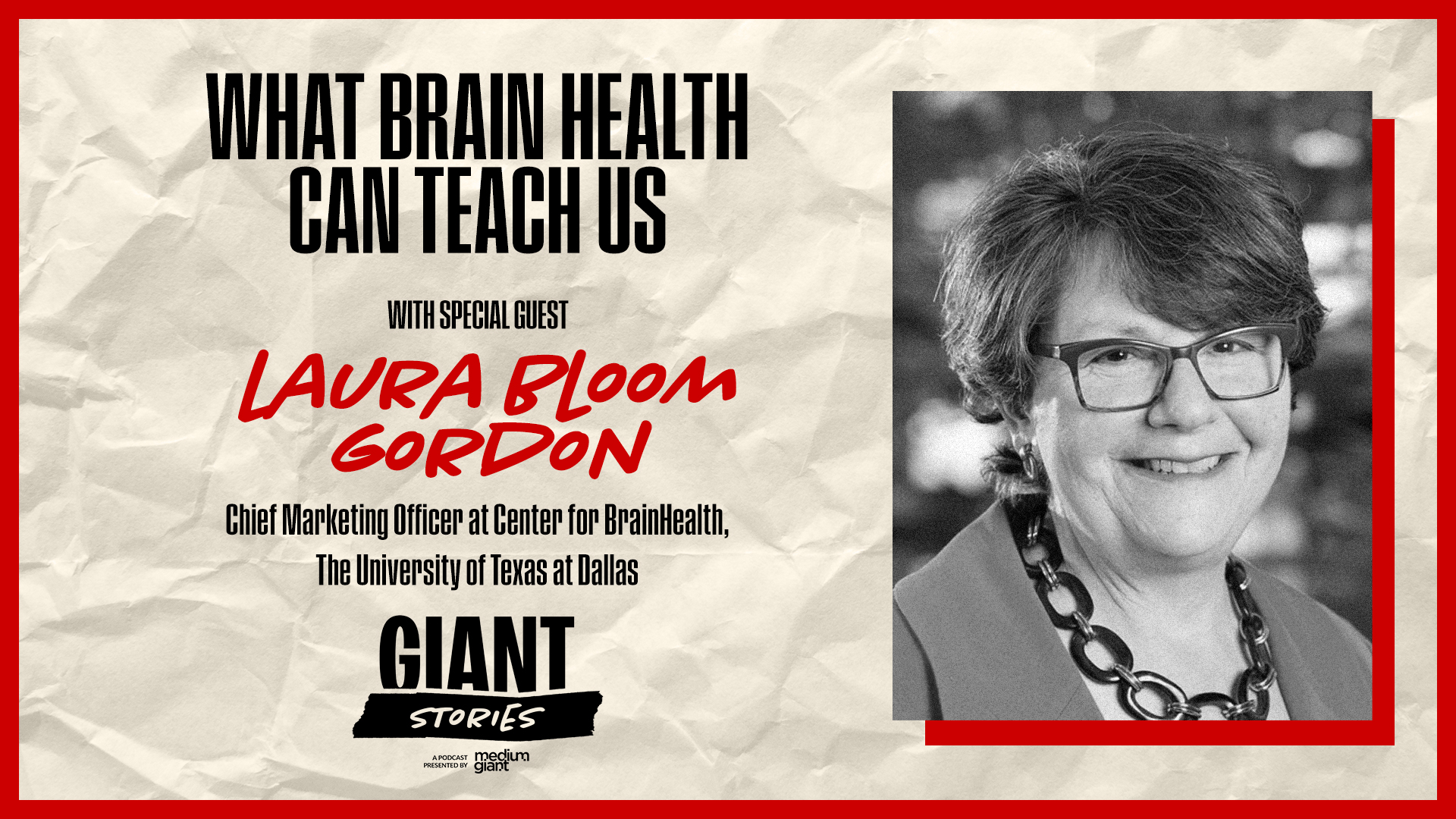
[00:00:00] Welcome to Giant Stories, a podcast inspired by people and brands with meaningful stories to share. I’m John Kiker, your host and president of Medium Giant, a fully integrated creative marketing agency in Dallas, Texas. Today I’m excited to introduce a dynamic marketing leader whose career reflects innovation across industries.
[00:00:15] Laura Gordon is the Chief Marketing Officer at the Center for Brain Health at the University of Texas at Dallas, where she’s advancing the conversation around cognitive wellbeing. And making the latest in brain science accessible to public through power to the public through powerful storytelling.
[00:00:29] Laura brings a wealth of experience from her previous roles as the head of marketing at seven 11, where she shaped national branding strategies for one of the world’s most recognized retail brands. And as CMO at the Dallas Morning News, helping to redefine how local journalism connects with audiences in a digital world.
[00:00:44] Now at the Center for Brain Health. Laura is using her expertise to amplify scientific breakthroughs. How am I doing so far? Good. Great. Alright. Forge partnerships and make brain health actionable for all. Her passion is turning complex discoveries into stories that inspire positive change, reaching new [00:01:00] audiences, and reflecting the rapid advances taking place in neuroscience today.
[00:01:04] Also, a proud alumni of Northwestern University Business School, Kellogg, correct? Yes. I’m a double Northwestern, actually. A double. Okay. Not just undergrad, not just a single undergrad. I bleed purple. Well, they’re happen. They’re okay this year in football maybe. Did you see what happened this week? They, they beat Minnesota.
[00:01:22] Okay. The Golden Bill. Three points. I still dunno how it happened. Hey, take the win. Miracle. Take the win. Alright. Alright, Laura, thank you so much for joining us. We’re glad you’re here. Thank you for having me. Excited to do this. So, um, we always start these, these podcasts off with asking our guests, um, or giving them the platform to tell their story how they got to where they are today.
[00:01:38] You’ve obviously. Been at some amazing places throughout your career and been able to work with some amazing brands. So, um, would love our listeners just to hear a little bit about you and your background. Well, I think I, I have to start at the point of a dinner table conversation. Okay. Why it, which is, um, so I grew up in a family that owned an advertising agency.
[00:01:59] It’s called The [00:02:00] Bloom, a Bloom Agency. My grandfather started at age 57 with no high school education. It grew to be one of the largest in the Southwest before Bloom actually sold. And for me what that meant was my dad. My dad was the president and CEO. Eventually, every conversation at our dinner table on a Friday night was about what was happening at the agency, animating rabbits for seven Cs, salad dressing, which was a first, uh, getting to sit on Ronald McDonald’s shoes because they were housed in the closet.
[00:02:31] And for me, hearing about how. The agency was working to connect brands with people. I, I just sort of knew that that’s what I wanted to do, really what I wanted to do from a young age, from a, from a very young age. So I, I tried the agency business. I worked every summer at the Bloom Agency in Dallas. And then, um, actually after Northwestern chose to go to New York to work at the agency business.
[00:02:57] And I liked it, [00:03:00] but it wasn’t enough for me. Advertising was just one part of the picture. Mm-hmm. So for me. Going to Kellogg was actually pretty transformational because I got the opportunity to see different ways you can build marketing skills, and I got to learn a little bit more about not just using my gut judgment and sort of what I learned at the dinner table, right?
[00:03:20] But how to actually use some skills to build businesses. So how long between your Northwestern going to New York and then going back to be school? Four years. Okay. Four years. Four years in New York. Okay. 12 years. Anywhere else? Yes. Four years. Four years. And I think I just want you to know. Two highlights.
[00:03:39] I worked on the XLA account at the same time as I worked on Mentor Contraceptives, which was the first contraceptive marketed to women. Wow. So not very many people can say that. They sat through focus groups for both types of products. You are one of one in that regard. That is true, for sure. I have a, I have a deep and meaningful understanding of what it looks like for people to find each [00:04:00] other in those circumstances.
[00:04:01] Okay. Okay. Okay. We can talk about that later. I’ll just, I’ll leave it very for now. Okay. Alright. Um, so coming out of business school for me, I wanted a place where I could learn, and I started at a, a company called Helene Curtis, which became Unilever Home and Personal Care, got very traditional brand marketing.
[00:04:17] Mm-hmm. Background. Um, but pretty quickly I learned that the fundamentals were great and the ability to actually have big money was great, but what I really wanted to do was to innovate and I wanted to be in a place where I could use those skills to drive creative business expansion. Mm-hmm. So I left there to go to a place called Paris Presents, which had nothing to do with Paris or presenting.
[00:04:39] It was a small, privately held company in the bath and body and beauty category. And I got to be the head of product development with zero marketing budget. So you learn pretty quickly how do you, how to be scrappy. I was about to say a very bootstrapy, very scrappy, but you also learn that the product and the way that the product is [00:05:00] packaged and the way that the product is presented and the way the product is differentiated.
[00:05:04] Yeah, it has to stand on its own. And if you can do that, then you can tell a story. Mm-hmm. And you can grow sales and you can grow audience. And that’s where I first got, uh, actually introduced to retail. I probably worked at every major retailer that you can think of through that business. And I got a first view for, um, what it really meant to be successful in retail.
[00:05:29] Happy in that job. Loved living in Chicago. Yep. I ended up with a, with a kid who needed a different situation. Okay. And my husband and I moved to Dallas to put him in a school that was right for him. Okay. And I got, when I got here, uh, I actually found myself in the situation where I was gonna have my second child.
[00:05:50] Okay. So my plan to continue my work in Chicago, traveling back and forth, was not gonna be easy. Right. And at that point, I answered an ad for something [00:06:00] called Chief Innovation Officer at the Dallas Morning News. Yeah. And I thought to myself, okay, what exactly is that? Yes. Well, what was interesting for me was that it was the intersection between what I had done in the past, meaning build new products, innovate.
[00:06:17] Mm-hmm. Growing audiences, which I really understood from all the agency businesses I had worked on, but also, you know, previous work. And then getting to work, getting to work in a business that was. Insignificant transformation. Mm-hmm. And I think that’s actually slow down. That’s actually the story. Yeah.
[00:06:36] Right. The story for me is when I came to the Dallas Morning News and I worked here in innovation, I realized that what I love is being at the point of transformation. I love innovating. I love helping people do their work at points of transformation, even if it means some difficult things. Sure. And I enjoyed my work at the Dallas Morning News until the point at which it wasn’t the right thing for me anymore.[00:07:00]
[00:07:00] And I then at that point decided where else could I go that would be different, a different industry, uh, different experience, but also at a point of transformation. And that’s when I landed at seven 11. Um, seven 11 when I started, had 6,000 stores when I left almost 20,000 stores. When I started at seven 11, no digital platform when I left at seven 11, definitely digital as a strategy.
[00:07:28] Not, not, not as a tactic. No core. When I started at seven 11, uh, beverages were our strength. Yeah. When I left seven 11, food was our strength. So it was a place where I could actually innovate every single day. And I learned to do that through franchisees. Yep. And, and you learn the art of influencing.
[00:07:48] Again, for the size of organization, big budget, but not a national budget. Right? So having to make decisions about where you were gonna put your chips down and what you’re gonna be known for. [00:08:00] Really critical. I think one of the things that I’m probably most proud of is help them try to figure out what their value proposition was at that time.
[00:08:09] Mm-hmm. And we really worked on this idea of making the everyday better and it galvanized the organization well. ’cause that was also, that’s not just, and I think, you know, in, in such a heavily franchised organization, it’s not just with the customers, it’s getting the franchisees to buy in. So it’s a B2B strategy as much as it is.
[00:08:24] A B2C strategy That, that’s right. Um, and some of that I learned at the Dallas Morning News because Yep. We were marketing obviously to people who wanted to be readers and subscribers, but we were also trying to attract advertisers Sure. And make sure that they were happy. Um, and so I think the training here actually made a, a big difference.
[00:08:40] But working in a franchise organization is, is, is, is both a benefit and a challenge. Yes. They can tell you better than you can invent yourself how to do things better. So it’s where you learn to listen differently. It’s where you learn to operate differently. But for me, it was also where I learned the balance between being a strategic marketer, [00:09:00] innovator and being an operational marketer.
[00:09:03] Mm-hmm. Was sort of my sweet spot. Okay. Um, being able to actually operationalize new ideas. Mm-hmm. Meant you could move faster and you could be part of the growth story. And I think that’s what has attracted me in every career path that I’ve been on. That’s what’s really attracted me. Um, that and building great teams.
[00:09:22] Um, so, which is also evidence, by the way, for all the people you have out there leading other c-store organizations right now. We were just talking about that before the broadcast. Yeah. I’m, I’m really proud of the people that I worked with at seven 11, and I think they’ve all gone on to do great things.
[00:09:36] Yeah. Um, I think that says a lot to about, you know, if you, if you were an informal leader there and you had an idea and it fit with the business strategy, you got to do it. Yeah. It was a. Fun place to work. Um, from that standpoint, you could, if you could dream it, you could pretty much be it. Yep. Yep. Love it.
[00:09:57] Um, unfortunately for me, I had a life [00:10:00] circumstance that caused me to leave seven 11. Um, it’s really a, um, a, a situation that required me to step out of a long career. And I think what I would say to everybody that’s listening to this is, I think sometimes you think when these life things happened, quote unquote, life is over as you know it.
[00:10:17] Mm-hmm. You know, for me it was just, in many ways it was because of the difficulty of it at home, but it was a time where I really stepped back to try to figure out what it was that I really wanted to do after all the things that I had tried. Mm-hmm. And. While I had opportunities that looked like my job at seven 11 other CMO big CMO roles, I kept coming back to this one thing, which is I really wanna make a difference.
[00:10:45] Mm-hmm. And I feel like now I have enough skills to be able to do that. And I just didn’t quite know where to direct all that. I didn’t know whether I was just gonna be the greatest volunteer that has ever had been at, or whether, uh, you know, uh, I would actually [00:11:00] find something that fit me. And to be clear.
[00:11:03] I really didn’t want to go to an organization that had already figured it out. Hmm. I mean, you hear a theme here. Yeah. Um, I like to actually create and invent and make things. So I wanted a place. Sounds like setting an organization up for future success. Exactly. Yeah. Um, and I wanted to be in a place where what, whether, what what I could do would make a difference, but mostly where I could help the people make a difference.
[00:11:26] Um, so that brings me to sort of where I am today, which is. Lucky for me, um, both of my kids had actually done programs at the Center for Brain Health. I was on the board. Dr. Chapman called me to ask me a couple of questions because they were already thinking they’re a local organization. They think they wanna be national.
[00:11:44] Yeah. What do they need from a marketing standpoint? Right. I did a little bit of consulting, a little bit more consulting, a little bit more consulting. And what I would say to anybody who’s doing that kind of consulting is be careful what you recommend because you may find yourself actually executing it.
[00:11:57] Exactly. Exactly. Which is exactly what’s [00:12:00] happened to me. Um, and that’s really how I landed at the Center of Brain Health. I think for me, the surprise, my, you know, science was never a topic that I would’ve told you I would’ve been engaged in. I mean, I’m an, an English and French major, you know? Mm-hmm. With a business degree.
[00:12:16] Science was really out there for me. Mm-hmm. But what happened when I started working there is you realize that when you get to see science being created, the idea of liberating it to create impact is actually thrilling because you realize you’re changing lives and all the myths that you’re dispelling in the process.
[00:12:36] That’s right. So talk a little bit about the Brain Center, what their mission is. Yeah. And we’ll get into some of the stories because every. You know, ha, having, having been there, uh, with our team and sitting through all the sessions, I mean, I think we spent, you know, two and a half, three hours there, and I walked away with 10 things that just blew my mind that we just, you would just, you wouldn’t have, wouldn’t have thought.
[00:12:54] So. Yeah. Yeah. We, um, I’ll just, that’s the headline, John. Yeah. At Center for Brain Health, we want you to think [00:13:00] about how you think. So hopefully that’s, that’s a pretty punchy tagline. Yeah. You like that? Yeah. Thank you. It’s like you’re in marketing or something. Yeah. You, you. Well, I hope you like it.
[00:13:08] Hopefully it’s simple enough. Yeah. So Center for Brain Health was started 25 years ago by someone by the name of Dr. Sandy Chapman. She’s our founder and our chief director. Um, she is amazing. She, for many years was diagnosing okay. And her, the challenge with that is giving somebody a label. Doesn’t change their lives.
[00:13:30] Mm-hmm. It just gives them a label. So 25 years ago, she decided that rather than thinking about what was wrong with the brain, mm-hmm. She really wanted to put her emphasis and her neuroscience background into helping people understand how to strengthen and grow their brains. So for 25 years, she’s built the center.
[00:13:52] There really are two components of it. One is there are about 115 scientists that do work thinking about [00:14:00] brains from every angle. And the other side is a translation arm where that science comes off the shelf and we bring it to different parts of the community in order to impact people’s lives. Okay.
[00:14:11] Important. We are part of University of Texas at Dallas, which means that comes with. A lot of credibility. Sure. A lot of resource. Um, a lot of ways to actually make connections with other people. Um, but Dr. Chapman has really been a visionary in this space. Uh, you’ll be hard pressed to find any other organization in the world that thinks about the upward potential of the brain across lifespan.
[00:14:35] Mm-hmm. You might find somebody focused on a particular age group or demographic group, but not lifespan. Infant dementia, those kinds of things. From, from, yeah, from, from, from birth to to death essentially. Um, I think, you know, if you ask me what really makes us different today, what I would tell you is we launched in 2020, the largest longitudinal study of [00:15:00] the brain in the world called the Brain Health Project.
[00:15:03] It has 30,000 people that are actively participating in it. We are in part of every single state in the United States and in 68 countries. When you join the Brain Health Project, you take an assessment called the Brain Health Index. That Brain Health Index actually is the first holistic measure of brain health in the world invented at the Center for Brain Health.
[00:15:26] What’s important about that, and you and I both know this, is you manage what you measure, right? So without having a baseline, how do you know whether your brain is doing well or not progressing? Regressing? Right. So through the last five years of this study, what we’ve learned is that it doesn’t matter your age, your stage, your ethnicity, who you are, everybody actually has the potential.
[00:15:51] To improve and strengthen their brain. And that’s because your brain changes every minute of every day. So when you talk about improving and strengthening your brain, give some context to that. Like what would that, what would [00:16:00] an example of that be? Well, um, let’s start by telling you this, uh, your brain blood flow begins to decline at age 30.
[00:16:07] Okay. Okay. And so, and your speed of processing also starts to decline. Right. So we’re not, so if you wanna think about the physical changes to the brain. Yeah. What we wanna do is we wanna do things that actually produces more blood flow exercise, for lack of a better ex. It’s, it’s like, it’s exactly the same thing.
[00:16:25] It’s like the same thing you would do at the gym, right? Uh, we want to actually help people make more synapse connections because that actually breeds innovation and creativity. And we wanna do, we wanna help them actually do that in a way that thickens the parts of their brain that it, that, that supports them.
[00:16:46] To have a better long life L Jet from a longevity standpoint with a healthier brain over time, no matter the stress. Mm-hmm. So what does that look like? It’s really simple. I mean, it is really simple. And when [00:17:00] I tell you you’re gonna be like, okay, Laura, really? But one way you can actually strengthen your brain is literally by connecting with an with another person.
[00:17:10] So you go to see a movie, John. Mm-hmm. Instead of just thinking about how the movie was mm-hmm. Actually talking to the person. And that’s because when you actually talk to the person, you’re actually firing off synapses in your brain. You’re con, you’re actually synthesizing the information in a way that lets you connect with somebody else.
[00:17:27] Right. And it actually increases blood flow. Wow. Taking a brain break. Okay. If you had a car and it was. Uh, one of your favorite things, would you drive it at 200 miles an hour down the, down the road every day of the week? Probably not advisable Why that you’re, you’re gonna wreck it. Okay. You’re gonna, it’s gonna be tired, right?
[00:17:48] Yeah. It’s, you’re gonna, you’re gonna run it down before. Yeah. Well, we do that with our brains. We don’t ever turn them off. Especially now with, with these things in our hands. That’s right. Technology. Technology has played a big role in our [00:18:00] distractedness. So another simple suggestion is just taking five, five minute brain breaks a day and what is a brain break?
[00:18:07] It means you actually have to disconnect from people in technology for five minutes. What’s the benefit of that? You actually lower your cortisol. Mm-hmm. Which we all know is part of your stress response. You, you give your synapses time to actually connect with each other and you come out of a brain break with more, more of what we call cognitive reserve.
[00:18:27] So cognitive reserve, big term, but what it really means is having more energy in your brain to do the things you really wanna do. So I don’t know about you, but how do you feel at the end of your day, like when you come home from a really hard day at work? Pretty ghast, right? Okay. So the idea here is teaching people how they can have self-agency.
[00:18:47] To create cognitive reserve for themselves so they can do more of what they wanna do. And that’s something simple, like just take a walk, meditate. Exactly. Something simple like that. All all of those things, all of those can things contribute. Um, here’s a little secret. [00:19:00] Um, compassion is actually one of the most, uh, healthy things for your brain.
[00:19:05] And I’m not talking about just ’cause you’re doing good. Turns out that when you have compassion, you actually have to see the person in front of you. Mm-hmm. You have to connect to something that matters to you. Mm-hmm. You have to decide what you wanna do about it. You have to act. You have to connect with that person.
[00:19:22] Hear what I’m saying? Mm-hmm. It’s all these small steps mm-hmm. That actually juices your brain. Mm-hmm. So really going back to that whole great marketing slogan that you talked about that, think about how you think. Yeah. What we really want people to do is to be much more intentional about thinking about their brain.
[00:19:40] I mean, you and I have had this conversation. You spend more time thinking about when you’re gonna brush your teeth than you do your brain and your brain literally runs every single solitary part of your body. So yeah, I’m sort of jazzed about this idea that people’s overall wellbeing can be absolutely better if we think about [00:20:00] our brains just a little bit more.
[00:20:02] Doesn’t cost anything. No, it’s in our control and it works on everyone. It meets you where you are. That’s just the most amazing part about all of this. So talk about one of the applications that, that I, I, I was blown away by was the work you guys are doing with the military. Yeah. And talk about that because I, I, I think it’s, you know, for, for people and an organization, especially those who’ve been in combat, the trauma that they experience, the readiness that they have to have.
[00:20:30] To go and serve and, and do what they need to do. Obviously the, the stress it puts on your brain is immense. And so talk about the work that you guys are doing with them. Yeah. Um, we have, uh, worked with, um, over 10,000 people in the military, um, over the course of the history of the center, and I would say ranging from people who have had very significant injuries to people who are leaders in combat.
[00:20:57] Yep. And the. [00:21:00] Common. The common theme is all of these people have at one point operated literally in the top 1%, meaning they, they have to be able to respond to whatever they deal with in minutes, and they usually are responsible for lots of people. Special forces, special forces, all the Navy Seals, all of that.
[00:21:25] So what happens if. Somebody is injured or somebody is what? What happens if somebody’s injured? Well, the truth of the matter is having them adopt these brain healthy principles and get treatment through traditional means. Sure. Speeds. The response to wellness helps them get back to what they were doing in a way that they say is really about how they really feel.
[00:21:52] Not just checking a box based on a medical survey that says passing a fitness test or whatever that says you’re ready, but actually being their best selves. [00:22:00] And then the most important piece is they come back and they say they’re better, not only down range, but at home. Because if they, if they have the.
[00:22:10] You know, self-agency to direct their own brain health. They can apply it to almost any situation. Um, for, for us, what we’re trying to do with the military is we want the military to think about their brain mm-hmm. As if it were a single issue boot. Mm-hmm. Love it. Um, you know, you only get one. We ha we have to teach people how to take care of them.
[00:22:34] And when we do the, the follow on impact is incredible. Now. Today, warfare is so different. Yes, it is. It is. It is instantaneous. It is technical. It is. It, it is faster pace than it ever has been before. Sometimes intense in person, sometimes now distance where you’re watching on a screen, right? Correct. And so, so how do you take, how do you take that 1% and actually have them [00:23:00] operate 1% better?
[00:23:01] Well, for us it’s all about optimizing, truly optimizing the brain. And that’s, that’s what we’re, that’s what we’re working on with the military. We are currently. Training trainers who know how to train military. And our goal is to be a standard operating procedure in the military. And I think we’re, we’re get, we’re getting very close.
[00:23:21] We’re getting very close. That’s amazing. Yeah. That’s amazing. I, I think the other work that we’re doing that is extremely meaningful is what we’re doing with middle school kids. Okay. We’ve seen over a hundred thousand middle schoolers. Um, we go into the classroom and we actually train the teachers. Yeah.
[00:23:35] And basically it’s what you and I would know as executive function. Mm-hmm. If you kid think kids teach kids to think, uh, uh, more, uh, more strategically top down as as, as opposed to bottom up, tactical up. Right? They become problem solvers. They start to approach things differently. The results have been unbelievable.
[00:23:55] Um, in kids that have gone through this program, [00:24:00] they, uh, all have. Reported 60% less stress and anxiety. Their great, their star scores have improved significantly. And we’ve even had school, whole schools that have gone through the program where they’ve gone from a ranking of unacceptable to being a a, a star stellar school.
[00:24:18] I would think that their self-awareness just explodes in a positive way. And then last part is we just did some work with the TA and we can actually start to see the long-term impact. Graduation rates are higher. Uh, they’re better in math, which is interesting because it’s taught in social studies and English.
[00:24:37] Interesting. So basically the message here is getting in early does matter. If we could do it for every middle schooler, imagine the transformation ly that we could happen, because middle school’s a really tough transition time. Oh yeah. So I think the thing that I’m, I get excited about is brain health.
[00:24:58] Has the potential [00:25:00] to be so transformative, especially with this Brain health index. But telling the story, I mean, okay, John, if I ask you to work on your brain and you, you’d nod at me, what are the chances that you’d actually do it? Uh, pretty minimal. I’d be like, what do you mean? Like, go meditate? Like Yeah, exactly.
[00:25:16] You know, or, you know, uh, take, like I said, take a walk, meditate, maybe, um, you know, spend some time just, you know, going off my screen. And that’s probably about it. Okay. So. Yeah, that’s the marketing challenge. Yeah. The marketing challenge is number one, to get people to think about their brain. Number two, to take an action on their brain.
[00:25:33] And number three, to have them feel that. To have them stick with it, you know, to have them really stick with it. But I think what’s beautiful that you’ve articulated is that there’s the exercises to do something like that are so simple. Like literally, you know, talk to somebody, have a conversation. Um, be empathetic.
[00:25:50] Um, you know, those deliberate actions that, you know, if people of, of, of good nature do all the time anyway, but just to sort of be conscious that you’re doing it and the, and the impact that it’s having. I would think [00:26:00] that sort of, yeah, it’s just so easy. So, so how do you guys get, like, if you think about all the stories out there that you can tell in all the examples, like how do you prioritize what you do?
[00:26:09] Because there’s so many places you can go and there’s so many different groups and constituencies that you can impact with what you guys are doing. Yeah, I mean, first of all, uh, that’s just a, that, that is a hard, that’s a really hard question because I think, um, what we wanna make sure we’re doing is that we’re, um, able to go where, where the impact story is large enough that, that ultimately, that becomes a story that people gravitate to, to believe.
[00:26:36] So. Most people believe that if it’s good enough for the military, it it means that it’s gonna be good enough for them. Yeah. Right. And almost everybody can relate to the difficulty of being in a middle school. Sure. A middle school environment. So I think that’s, those are the, those are the two pieces. I, I, you know, I think, um, the key here, a couple of keys.
[00:26:55] One is. Making sure that we’re telling the stories that, [00:27:00] uh, inspire, uh, fundraising, uh, and philanthropy. Yeah. So that, so that we can keep the science going. So, um, I think for, for, for us, we’re organized. We’re organized in order to be able to translate like this. Yep. Um, but I think in terms of breaking through, that’s where, that’s where the biggest C cha, that’s where the biggest challenge is now, you know, talking to people who are working.
[00:27:26] That is the most interesting conversation I think that we’re having right now. Because if people who are working actually just paid attention to their toxic habits first just did a simple eight. Eight, yeah. Eight question quiz. Are you in back to back meetings? Yes or no? Uh, do do you line up the work that you do with the best brain time that you have?
[00:27:53] Is your deepest thinking lined up with that? Yes or no? Simple questions like that. I think our biggest is the last thing you do before you go to [00:28:00] bed. Put your phone down. Yes. E exactly. I mean really. I mean, exactly. So for, for us, it’s sort of like how do you get people to actually just think about their toxic habits, get them to stop doing that.
[00:28:12] But I think you have to have people feel the impact of this, and that’s why, that’s why this idea of. You know, I’m gonna, uh, I’ll tell a story that I think is so interesting is one of the factors that we’ve learned really improves brain health is strategic focus. Okay. Strategic focus has more to do with what you don’t pay attention to than it does what you do.
[00:28:35] Pay attention to strategy is sacrifice. That is right. So the, I think what, um, you know, what we like to preach, uh, at Center for Brain Health is. This idea of elephants and rabbits. Mm-hmm. So don’t, when you’re chasing elephants, don’t get distracted by the rabbits. Right? So that’s what you were just talking about.
[00:28:58] Where can you, where do [00:29:00] you, where is your brain energy really required in order for you to do your very best work? Make sure you’re doing that. Make sure you’re setting time aside for that. Make sure you’re doing that in a way that preserves your greatest benefit. Then how do we tell the stories? How do we tell the stories of the people in the workplace who, who have been able to do more as a function of that?
[00:29:24] How do we tell the story of the, the importance of, um, connecting to people and purpose? How do we tell the story about, um, the importance of resilience and emotional balance? One thing that really, that I really relate to is this concept of if you. Coming up with the come, instead of coming up with one answer, the get the idea is coming up with seven ways to do anything.
[00:29:53] Absolutely. Okay. Well, what is, what is that all about? Well, if I told you it has to be a certain way, your brain is [00:30:00] completely wired to it has to be that way. Get to the thing. Get to the thing. Exactly. But if you find seven different approaches to it, that means that there’s lots of different ways it automatically brings your stress level down.
[00:30:11] Yeah. Anyway. Making these things accessible in tools. That’s the answer. That’s the answer that I was gonna give you is that whether it’s the toxic habits quiz or a sleep text challenge, because sleep is so vital to brain health or a little mini quiz, or helping people get curious about brain health. Yep.
[00:30:30] That’s what’s, that’s what we’re really working on. It’s funny the application with the military that you guys have, or middle school students, because you know, as somebody in like yourself who’s worked in a very high stress, um, fast paced environment, I would think that the business health applications are, are, are, are endless.
[00:30:45] Because think about it, if I’m spending in anor amount of my, of my brain capacity focusing on problems that really at the end of the day aren’t gonna make a measurable impact, like, what am I doing? You know, do, do I have my priorities in line? Do I need to reassess? Do I am, am I at the [00:31:00] right place? Like, you know, right.
[00:31:01] I, I think that there’s a, there’s so much that can translate over to the workplace for anybody to sort of ask themselves those questions and so doing, make themselves healthier, but also, you know, improve their day-to-day experience. Right. Yeah. So, I mean. And, and what we’ve observed is when people start to adopt these behaviors, it actually has a, a sort of a cascading impact.
[00:31:21] Yeah. Because if you do it and there’s a common language and you can bring your team along Yeah. Then the whole team starts to practice it a hundred percent. Um, it affects how people choose to stay. It affects people’s job satisfaction. It affects people’s innovation capability. I was gonna say creativity.
[00:31:38] It’s closed. Creates huge creativity. Huge creativity, opportunity. I, I think that the other pieces is that I don’t know about you, but everybody that I know that’s in the workforce is not just managing their job, they’re managing a, a parent or a child. Sure, sure. So that concept of sort of having to be split in both places, if you can use your brain more efficiently, imagine the [00:32:00] energy that you would have to, to, to actually do those things.
[00:32:03] It, it totally reframes the concept of work life balance. And what it really is, is capacity for, like, what are you reserving for, for outside the office and what are you reserving for and is, and is that balance. Where it needs to be. That’s right. So, that’s right. That’s right. And that’s where catching, catching, catching stories of people who have felt that benefit and the, and what it has meant to them.
[00:32:25] Yep. But I don’t, I don’t wanna, I don’t wanna leave the conversation and have this be all touchy feely, because actually we have a practice at the Center for Brain Health called Brain Omics. Clever term. Sandy trademarked it 20 years ago, knowing that she was wanting to look at the economic impact mm-hmm.
[00:32:42] Of focusing on the upward potential of the brain. I mean, every data point that you read about is all about what the cost of illness is. Sure. Well, what about the benefit of brain wellness? Of wellness? Right. Well, we’re, we’ve got a practice. We’re beginning to build case studies, working [00:33:00] with organizations, doing the math to be able to see.
[00:33:03] We know what it looks like now in middle school. Mm-hmm. So if, if we can actually have somebody earn 10 times more because they are, they’ve taken this program, imagine what the potential, uh, is of this. In the workplace. Yeah. In the military, in the medical world. Absolutely. Someday, I hope we are all going into our doctor and they’re handing us a brain health index and everybody’s talking brain, we’re just all talking brain.
[00:33:29] I love it. So. As technology and, and the advancements in brain study just accelerate, just the pace is incredible. What, what are you most excited about in the next five years? What’s gonna happen with brain health awareness? Ooh. What am I most excited about? Um, well, I, there’s a lot of things I’m most excited about.
[00:33:47] Um, I think, uh, brain health will be, uh, there’ll be precision brain health. You’ll have a brain health agent that will help you through your specific. [00:34:00] Uh, situation. Using the data and the science that we’ve created that is going to help you at any point in time in your day, optimize your brain. So if you need a coach, you’ll have one right there.
[00:34:11] Here’s what I’m feeling. Yeah. You’ll, if you need a coach, you’ll have one right there. So I’m, I’m excited about that. I’m also excited about the opportunity to truly scale what we’re doing. Um, we are definitely working with ai, as you might imagine. Um, right now there’s a lot of personalized coaching that happens inside of what we do.
[00:34:28] Sure. If we can recreate that through AI and know that it can be delivered in a, in a way that is consistent with the way that we’ve been delivering it, democratize we, if we can, then it can be accessible to everyone. Yeah. I mean, I’m, I, I, you know, I, I think about the people that struggle to put. Food on the table.
[00:34:46] In many ways, they need this more than absolutely anybody else, but time is of the essence. It needs to be able to meet them really where they are. And maybe starting with sleep is the right answer there. Right. Um, I’m very excited that Dr. Matt Walker is joining Center [00:35:00] for Brain Health. Tell Smart. Um, he is the world’s renowned expert on sleep.
[00:35:04] Um, he is coming to us from, uh, Berkeley. He is choosing to be at UTD and Center for Brain Health because he believes that. There is no illness, whether it’s mental or physical, that doesn’t first start with a sleep disruption. And he wants to use his sleep science in combination with biotechnology in order to advance the understanding of sleep disruption.
[00:35:27] So that what we can all know when sleep disruption is happening. Mm-hmm. Well before it actually disrupts us. Mm-hmm. And we can actually help either get ahead of it. Yeah, get ahead of it, or maybe make an illness. Not be as, as acute. He is going to bring a true innovation center to the center for brain health.
[00:35:47] That’s fantastic. You will see new technology, you will see education, you will see ways that sleep is going to be very transformative. We like to say, uh, brain health starts at night. Mm-hmm. That’s [00:36:00] true. If you get a good night’s sleep, you are hands down starting your day in a much better place. So I’m, I’m very excited about.
[00:36:07] What that’s going to bring. And then I think, um, probably last but not least, we, we are starting a brain health research network. Okay. What that means is we’re basically making our data available to other scientists, love it. And already 12 scientists have grabbed the data. Their discovery is going to be very meaningful.
[00:36:27] We’re accelerating the science of this, of this sort of growth mindset in brain going open source, right? And we’re going open source. And the reason for that is because the faster we can get this into the, into the discovery mode, the more people that we can impact. And back to that precision piece. Yep.
[00:36:45] Maybe people won’t have to do an MRI in the future. It’s uh, it’s pretty astounding what some of the work that’s being done gonna, that’s so exciting. Um, this. In February, we’re going to have Brain Health Week, and we do that every February. [00:37:00] We try to bring more people to understand and to participate in brain health.
[00:37:06] This year we’re having a technology expo because. We’ve gone from using cons, computer interfaces, to work on brain to actually using our bodies to work on brain. So I’m also really excited about biosensor technology and where biosensor technology, neuroscience and medicine. A a ring here. Well, there you go.
[00:37:27] See you, you’re And Aura is gonna be there, so, oh, really? Fantastic. Yeah. Very cool. So that’s the, that’s the whole idea is to give people an understanding of how all these pieces and parts sort of fit together. So, um. We have a lot of fun doing this, which sounds sort of crazy. We, we create these things called no-brainers, KNOW, no-brainers.
[00:37:47] Oh my God. Um, yeah, I know. Um, where we sort of marry a little bit of the science. I mean, I’m proud to be now part of the, the scientific community because there is so much misinformation out there. How getting the, getting [00:38:00] information that’s backed by science out there in a credible way that is easily accessible to people.
[00:38:06] In a simple way is really what, it’s a great marketing challenge. Yeah, it is. And that’s what, that’s, it’s got my brain going. Love it. Love it. Laura, this has been an awesome conversation. Thank you for using this platform to talk about brain health and just like I said at the beginning of our conversation, to dispel some medicine, um, where they’re going and what you guys are accomplishing and your ability to tell that story is awesome.
[00:38:26] So, uh, this was, this was great. Thank you for joining me. Thanks for having me. Appreciate it. Alright.
[00:38:30] Welcome to Giant Stories, a podcast inspired by people and brands with meaningful stories to share. I’m John Kier, your host and president of Medium Giant, a fully integrated creative agency in Dallas, Texas. Today I’m excited to introduce a dynamic marketing leader whose career reflects innovation across industries.
[00:38:46] Laura Gordon is the Chief Marketing Officer at the Center for Brain Health at the University of Texas at Dallas, where she’s advancing the conversation around cognitive wellbeing. And making the latest in brain science accessible to public through power to the public through powerful [00:39:00] storytelling.
[00:39:00] Laura brings a wealth of experience from her previous roles as the head of marketing at seven 11, where she shaped national branding strategies for one of the world’s most recognized retail brands. And as CMO at the Dallas Morning News, helping to redefine how local journalism connects with audiences in a digital world.
[00:39:15] Now at the Center for Brain Health. Laura is using her expertise to amplify scientific breakthroughs. How am I doing so far? Good. Great. Alright. Forge partnerships and make brain health actionable for all. Her passion is turning complex discoveries into stories that inspire positive change, reaching new audiences, and reflecting the rapid advances taking place in neuroscience today.
[00:39:35] Also, a proud alumni of Northwestern University Business School, Kellogg, correct? Yes. I’m a double Northwestern, actually. A double. Okay. Not just undergrad, not just a single undergrad. I bleed purple. Well, they’re happen. They’re okay this year in football maybe. Did you see what happened this week? They, they beat Minnesota.
[00:39:52] Okay. The Golden Bill. Three points. I still dunno how it happened. Hey, take the win. Miracle. Take the win. Alright. Alright, Laura, thank you so much for joining us. [00:40:00] We’re glad you’re here. Thank you for having me. Excited to do this. So, um, we always start these, these podcasts off with asking our guests, um, or giving them the platform to tell their story how they got to where they are today.
[00:40:09] You’ve obviously. Been at some amazing places throughout your career and been able to work with some amazing brands. So, um, would love our listeners just to hear a little bit about you and your background. Well, I think I, I have to start at the point of a dinner table conversation. Okay. Why it, which is, um, so I grew up in a family that owned an advertising agency.
[00:40:30] It’s called The Bloom, a Bloom Agency. My grandfather started at age 57 with no high school education. It grew to be one of the largest in the Southwest before Bloom actually sold. And for me what that meant was my dad. My dad was the president and CEO. Eventually, every conversation at our dinner table on a Friday night was about what was happening at the agency, animating rabbits for seven Cs, salad dressing, which was a first, uh, getting to sit on Ronald McDonald’s [00:41:00] shoes because they were housed in the closet.
[00:41:02] And for me, hearing about how. The agency was working to connect brands with people. I, I just sort of knew that that’s what I wanted to do, really what I wanted to do from a young age, from a, from a very young age. So I, I tried the agency business. I worked every summer at the Bloom Agency in Dallas. And then, um, actually after Northwestern chose to go to New York to work at the agency business.
[00:41:28] And I liked it, but it wasn’t enough for me. Advertising was just one part of the picture. Mm-hmm. So for me. Going to Kellogg was actually pretty transformational because I got the opportunity to see different ways you can build marketing skills, and I got to learn a little bit more about not just using my gut judgment and sort of what I learned at the dinner table, right?
[00:41:51] But how to actually use some skills to build businesses. So how long between your Northwestern going to New York and then going back to be school? [00:42:00] Four years. Okay. Four years. Four years in New York. Okay. 12 years. Anywhere else? Yes. Four years. Four years. And I think I just want you to know. Two highlights.
[00:42:10] I worked on the XLA account at the same time as I worked on Mentor Contraceptives, which was the first contraceptive marketed to women. Wow. So not very many people can say that. They sat through focus groups for both types of products. You are one of one in that regard. That is true, for sure. I have a, I have a deep and meaningful understanding of what it looks like for people to find each other in those circumstances.
[00:42:32] Okay. Okay. Okay. We can talk about that later. I’ll just, I’ll leave it very for now. Okay. Alright. Um, so coming out of business school for me, I wanted a place where I could learn, and I started at a, a company called Helene Curtis, which became Unilever Home and Personal Care, got very traditional brand marketing.
[00:42:48] Mm-hmm. Background. Um, but pretty quickly I learned that the fundamentals were great and the ability to actually have big money was great, but what I really wanted to do was to innovate and I wanted to [00:43:00] be in a place where I could use those skills to drive creative business expansion. Mm-hmm. So I left there to go to a place called Paris Presents, which had nothing to do with Paris or presenting.
[00:43:10] It was a small, privately held company in the bath and body and beauty category. And I got to be the head of product development with zero marketing budget. So you learn pretty quickly how do you, how to be scrappy. I was about to say a very bootstrapy, very scrappy, but you also learn that the product and the way that the product is packaged and the way that the product is presented and the way the product is differentiated.
[00:43:35] Yeah, it has to stand on its own. And if you can do that, then you can tell a story. Mm-hmm. And you can grow sales and you can grow audience. And that’s where I first got, uh, actually introduced to retail. I probably worked at every major retailer that you can think of through that business. And I got a first view for, um, what it really meant to be successful in retail.[00:44:00]
[00:44:00] Happy in that job. Loved living in Chicago. Yep. I ended up with a, with a kid who needed a different situation. Okay. And my husband and I moved to Dallas to put him in a school that was right for him. Okay. And I got, when I got here, uh, I actually found myself in the situation where I was gonna have my second child.
[00:44:21] Okay. So my plan to continue my work in Chicago, traveling back and forth, was not gonna be easy. Right. And at that point, I answered an ad for something called Chief Innovation Officer at the Dallas Morning News. Yeah. And I thought to myself, okay, what exactly is that? Yes. Well, what was interesting for me was that it was the intersection between what I had done in the past, meaning build new products, innovate.
[00:44:47] Mm-hmm. Growing audiences, which I really understood from all the agency businesses I had worked on, but also, you know, previous work. And then getting to work, [00:45:00] getting to work in a business that was. Insignificant transformation. Mm-hmm. And I think that’s actually slow down. That’s actually the story. Yeah.
[00:45:07] Right. The story for me is when I came to the Dallas Morning News and I worked here in innovation, I realized that what I love is being at the point of transformation. I love innovating. I love helping people do their work at points of transformation, even if it means some difficult things. Sure. And I enjoyed my work at the Dallas Morning News until the point at which it wasn’t the right thing for me anymore.
[00:45:30] And I then at that point decided where else could I go that would be different, a different industry, uh, different experience, but also at a point of transformation. And that’s when I landed at seven 11. Um, seven 11 when I started, had 6,000 stores when I left almost 20,000 stores. When I started at seven 11, no digital platform when I left at seven 11, definitely digital as a strategy.
[00:45:59] Not, not, [00:46:00] not as a tactic. No core. When I started at seven 11, uh, beverages were our strength. Yeah. When I left seven 11, food was our strength. So it was a place where I could actually innovate every single day. And I learned to do that through franchisees. Yep. And, and you learn the art of influencing.
[00:46:19] Again, for the size of organization, big budget, but not a national budget. Right? So having to make decisions about where you were gonna put your chips down and what you’re gonna be known for. Really critical. I think one of the things that I’m probably most proud of is help them try to figure out what their value proposition was at that time.
[00:46:40] Mm-hmm. And we really worked on this idea of making the everyday better and it galvanized the organization well. ’cause that was also, that’s not just, and I think, you know, in, in such a heavily franchised organization, it’s not just with the customers, it’s getting the franchisees to buy in. So it’s a B2B strategy as much as it is.
[00:46:55] A B2C strategy That, that’s right. Um, and some of that I learned at the Dallas Morning News [00:47:00] because Yep. We were marketing obviously to people who wanted to be readers and subscribers, but we were also trying to attract advertisers Sure. And make sure that they were happy. Um, and so I think the training here actually made a, a big difference.
[00:47:11] But working in a franchise organization is, is, is, is both a benefit and a challenge. Yes. They can tell you better than you can invent yourself how to do things better. So it’s where you learn to listen differently. It’s where you learn to operate differently. But for me, it was also where I learned the balance between being a strategic marketer, innovator and being an operational marketer.
[00:47:33] Mm-hmm. Was sort of my sweet spot. Okay. Um, being able to actually operationalize new ideas. Mm-hmm. Meant you could move faster and you could be part of the growth story. And I think that’s what has attracted me in every career path that I’ve been on. That’s what’s really attracted me. Um, that and building great teams.
[00:47:53] Um, so, which is also evidence, by the way, for all the people you have out there leading other c-store organizations right now. We were just [00:48:00] talking about that before the broadcast. Yeah. I’m, I’m really proud of the people that I worked with at seven 11, and I think they’ve all gone on to do great things.
[00:48:07] Yeah. Um, I think that says a lot to about, you know, if you, if you were an informal leader there and you had an idea and it fit with the business strategy, you got to do it. Yeah. It was a. Fun place to work. Um, from that standpoint, you could, if you could dream it, you could pretty much be it. Yep. Yep. Love it.
[00:48:28] Um, unfortunately for me, I had a life circumstance that caused me to leave seven 11. Um, it’s really a, um, a, a situation that required me to step out of a long career. And I think what I would say to everybody that’s listening to this is, I think sometimes you think when these life things happened, quote unquote, life is over as you know it.
[00:48:48] Mm-hmm. You know, for me it was just, in many ways it was because of the difficulty of it at home, but it was a time where I really stepped back to try to figure out what [00:49:00] it was that I really wanted to do after all the things that I had tried. Mm-hmm. And. While I had opportunities that looked like my job at seven 11 other CMO big CMO roles, I kept coming back to this one thing, which is I really wanna make a difference.
[00:49:16] Mm-hmm. And I feel like now I have enough skills to be able to do that. And I just didn’t quite know where to direct all that. I didn’t know whether I was just gonna be the greatest volunteer that has ever had been at, or whether, uh, you know, uh, I would actually find something that fit me. And to be clear.
[00:49:33] I really didn’t want to go to an organization that had already figured it out. Hmm. I mean, you hear a theme here. Yeah. Um, I like to actually create and invent and make things. So I wanted a place. Sounds like setting an organization up for future success. Exactly. Yeah. Um, and I wanted to be in a place where what, whether, what what I could do would make a difference, but mostly where I could help the people make a difference.
[00:49:57] Um, so that brings me to [00:50:00] sort of where I am today, which is. Lucky for me, um, both of my kids had actually done programs at the Center for Brain Health. I was on the board. Dr. Chapman called me to ask me a couple of questions because they were already thinking they’re a local organization. They think they wanna be national.
[00:50:15] Yeah. What do they need from a marketing standpoint? Right. I did a little bit of consulting, a little bit more consulting, a little bit more consulting. And what I would say to anybody who’s doing that kind of consulting is be careful what you recommend because you may find yourself actually executing it.
[00:50:28] Exactly. Exactly. Which is exactly what’s happened to me. Um, and that’s really how I landed at the Center of Brain Health. I think for me, the surprise, my, you know, science was never a topic that I would’ve told you I would’ve been engaged in. I mean, I’m an, an English and French major, you know? Mm-hmm. With a business degree.
[00:50:47] Science was really out there for me. Mm-hmm. But what happened when I started working there is you realize that when you get to see science being created, the idea of liberating it to [00:51:00] create impact is actually thrilling because you realize you’re changing lives and all the myths that you’re dispelling in the process.
[00:51:07] That’s right. So talk a little bit about the Brain Center, what their mission is. Yeah. And we’ll get into some of the stories because every. You know, ha, having, having been there, uh, with our team and sitting through all the sessions, I mean, I think we spent, you know, two and a half, three hours there, and I walked away with 10 things that just blew my mind that we just, you would just, you wouldn’t have, wouldn’t have thought.
[00:51:25] So. Yeah. Yeah. We, um, I’ll just, that’s the headline, John. Yeah. At Center for Brain Health, we want you to think about how you think. So hopefully that’s, that’s a pretty punchy tagline. Yeah. You like that? Yeah. Thank you. It’s like you’re in marketing or something. Yeah. You, you. Well, I hope you like it.
[00:51:39] Hopefully it’s simple enough. Yeah. So Center for Brain Health was started 25 years ago by someone by the name of Dr. Sandy Chapman. She’s our founder and our chief director. Um, she is amazing. She, for many years was diagnosing okay. And her, the challenge with that is giving somebody a label. [00:52:00] Doesn’t change their lives.
[00:52:00] Mm-hmm. It just gives them a label. So 25 years ago, she decided that rather than thinking about what was wrong with the brain, mm-hmm. She really wanted to put her emphasis and her neuroscience background into helping people understand how to strengthen and grow their brains. So for 25 years, she’s built the center.
[00:52:23] There really are two components of it. One is there are about 115 scientists that do work thinking about brains from every angle. And the other side is a translation arm where that science comes off the shelf and we bring it to different parts of the community in order to impact people’s lives. Okay.
[00:52:42] Important. We are part of University of Texas at Dallas, which means that comes with. A lot of credibility. Sure. A lot of resource. Um, a lot of ways to actually make connections with other people. Um, but Dr. Chapman has really been a visionary in this space. Uh, you’ll be hard pressed to find any other [00:53:00] organization in the world that thinks about the upward potential of the brain across lifespan.
[00:53:05] Mm-hmm. You might find somebody focused on a particular age group or demographic group, but not lifespan. Infant dementia, those kinds of things. From, from, yeah, from, from, from birth to to death essentially. Um, I think, you know, if you ask me what really makes us different today, what I would tell you is we launched in 2020, the largest longitudinal study of the brain in the world called the Brain Health Project.
[00:53:33] It has 30,000 people that are actively participating in it. We are in part of every single state in the United States and in 68 countries. When you join the Brain Health Project, you take an assessment called the Brain Health Index. That Brain Health Index actually is the first holistic measure of brain health in the world invented at the Center for Brain Health.
[00:53:57] What’s important about that, and you and I both know this, is [00:54:00] you manage what you measure, right? So without having a baseline, how do you know whether your brain is doing well or not progressing? Regressing? Right. So through the last five years of this study, what we’ve learned is that it doesn’t matter your age, your stage, your ethnicity, who you are, everybody actually has the potential.
[00:54:22] To improve and strengthen their brain. And that’s because your brain changes every minute of every day. So when you talk about improving and strengthening your brain, give some context to that. Like what would that, what would an example of that be? Well, um, let’s start by telling you this, uh, your brain blood flow begins to decline at age 30.
[00:54:38] Okay. Okay. And so, and your speed of processing also starts to decline. Right. So we’re not, so if you wanna think about the physical changes to the brain. Yeah. What we wanna do is we wanna do things that actually produces more blood flow exercise, for lack of a better ex. It’s, it’s like, it’s exactly the same thing.
[00:54:56] It’s like the same thing you would do at the gym, right? [00:55:00] Uh, we want to actually help people make more synapse connections because that actually breeds innovation and creativity. And we wanna do, we wanna help them actually do that in a way that thickens the parts of their brain that it, that, that supports them.
[00:55:17] To have a better long life L Jet from a longevity standpoint with a healthier brain over time, no matter the stress. Mm-hmm. So what does that look like? It’s really simple. I mean, it is really simple. And when I tell you you’re gonna be like, okay, Laura, really? But one way you can actually strengthen your brain is literally by connecting with an with another person.
[00:55:41] So you go to see a movie, John. Mm-hmm. Instead of just thinking about how the movie was mm-hmm. Actually talking to the person. And that’s because when you actually talk to the person, you’re actually firing off synapses in your brain. You’re con, you’re actually synthesizing the information in a way that lets you connect with somebody else.
[00:55:58] Right. And it actually increases blood [00:56:00] flow. Wow. Taking a brain break. Okay. If you had a car and it was. Uh, one of your favorite things, would you drive it at 200 miles an hour down the, down the road every day of the week? Probably not advisable Why that you’re, you’re gonna wreck it. Okay. You’re gonna, it’s gonna be tired, right?
[00:56:19] Yeah. It’s, you’re gonna, you’re gonna run it down before. Yeah. Well, we do that with our brains. We don’t ever turn them off. Especially now with, with these things in our hands. That’s right. Technology. Technology has played a big role in our distractedness. So another simple suggestion is just taking five, five minute brain breaks a day and what is a brain break?
[00:56:38] It means you actually have to disconnect from people in technology for five minutes. What’s the benefit of that? You actually lower your cortisol. Mm-hmm. Which we all know is part of your stress response. You, you give your synapses time to actually connect with each other and you come out of a brain break with more, more of what we call cognitive reserve.
[00:56:58] So cognitive reserve, big term, [00:57:00] but what it really means is having more energy in your brain to do the things you really wanna do. So I don’t know about you, but how do you feel at the end of your day, like when you come home from a really hard day at work? Pretty ghast, right? Okay. So the idea here is teaching people how they can have self-agency.
[00:57:17] To create cognitive reserve for themselves so they can do more of what they wanna do. And that’s something simple, like just take a walk, meditate. Exactly. Something simple like that. All all of those things, all of those can things contribute. Um, here’s a little secret. Um, compassion is actually one of the most, uh, healthy things for your brain.
[00:57:36] And I’m not talking about just ’cause you’re doing good. Turns out that when you have compassion, you actually have to see the person in front of you. Mm-hmm. You have to connect to something that matters to you. Mm-hmm. You have to decide what you wanna do about it. You have to act. You have to connect with that person.
[00:57:53] Hear what I’m saying? Mm-hmm. It’s all these small steps mm-hmm. That actually juices your brain. Mm-hmm. So really going [00:58:00] back to that whole great marketing slogan that you talked about that, think about how you think. Yeah. What we really want people to do is to be much more intentional about thinking about their brain.
[00:58:11] I mean, you and I have had this conversation. You spend more time thinking about when you’re gonna brush your teeth than you do your brain and your brain literally runs every single solitary part of your body. So yeah, I’m sort of jazzed about this idea that people’s overall wellbeing can be absolutely better if we think about our brains just a little bit more.
[00:58:33] Doesn’t cost anything. No, it’s in our control and it works on everyone. It meets you where you are. That’s just the most amazing part about all of this. So talk about one of the applications that, that I, I, I was blown away by was the work you guys are doing with the military. Yeah. And talk about that because I, I, I think it’s, you know, for, for people and an organization, especially those who’ve been in combat, the trauma that they experience, the [00:59:00] readiness that they have to have.
[00:59:01] To go and serve and, and do what they need to do. Obviously the, the stress it puts on your brain is immense. And so talk about the work that you guys are doing with them. Yeah. Um, we have, uh, worked with, um, over 10,000 people in the military, um, over the course of the history of the center, and I would say ranging from people who have had very significant injuries to people who are leaders in combat.
[00:59:27] Yep. And the. Common. The common theme is all of these people have at one point operated literally in the top 1%, meaning they, they have to be able to respond to whatever they deal with in minutes, and they usually are responsible for lots of people. Special forces, special forces, all the Navy Seals, all of that.
[00:59:56] So what happens if. Somebody is injured or [01:00:00] somebody is what? What happens if somebody’s injured? Well, the truth of the matter is having them adopt these brain healthy principles and get treatment through traditional means. Sure. Speeds. The response to wellness helps them get back to what they were doing in a way that they say is really about how they really feel.
[01:00:23] Not just checking a box based on a medical survey that says passing a fitness test or whatever that says you’re ready, but actually being their best selves. And then the most important piece is they come back and they say they’re better, not only down range, but at home. Because if they, if they have the.
[01:00:41] You know, self-agency to direct their own brain health. They can apply it to almost any situation. Um, for, for us, what we’re trying to do with the military is we want the military to think about their brain mm-hmm. As if it were a single issue boot. Mm-hmm. Love it. Um, [01:01:00] you know, you only get one. We ha we have to teach people how to take care of them.
[01:01:04] And when we do the, the follow on impact is incredible. Now. Today, warfare is so different. Yes, it is. It is. It is instantaneous. It is technical. It is. It, it is faster pace than it ever has been before. Sometimes intense in person, sometimes now distance where you’re watching on a screen, right? Correct. And so, so how do you take, how do you take that 1% and actually have them operate 1% better?
[01:01:32] Well, for us it’s all about optimizing, truly optimizing the brain. And that’s, that’s what we’re, that’s what we’re working on with the military. We are currently. Training trainers who know how to train military. And our goal is to be a standard operating procedure in the military. And I think we’re, we’re get, we’re getting very close.
[01:01:52] We’re getting very close. That’s amazing. Yeah. That’s amazing. I, I think the other work that we’re doing that is extremely meaningful is what we’re doing with middle school kids. Okay. [01:02:00] We’ve seen over a hundred thousand middle schoolers. Um, we go into the classroom and we actually train the teachers. Yeah.
[01:02:06] And basically it’s what you and I would know as executive function. Mm-hmm. If you kid think kids teach kids to think, uh, uh, more, uh, more strategically top down as as, as opposed to bottom up, tactical up. Right? They become problem solvers. They start to approach things differently. The results have been unbelievable.
[01:02:26] Um, in kids that have gone through this program, they, uh, all have. Reported 60% less stress and anxiety. Their great, their star scores have improved significantly. And we’ve even had school, whole schools that have gone through the program where they’ve gone from a ranking of unacceptable to being a a, a star stellar school.
[01:02:48] I would think that their self-awareness just explodes in a positive way. And then last part is we just did some work with the TA and we can actually start to see the long-term impact. [01:03:00] Graduation rates are higher. Uh, they’re better in math, which is interesting because it’s taught in social studies and English.
[01:03:08] Interesting. So basically the message here is getting in early does matter. If we could do it for every middle schooler, imagine the transformation ly that we could happen, because middle school’s a really tough transition time. Oh yeah. So I think the thing that I’m, I get excited about is brain health.
[01:03:29] Has the potential to be so transformative, especially with this Brain health index. But telling the story, I mean, okay, John, if I ask you to work on your brain and you, you’d nod at me, what are the chances that you’d actually do it? Uh, pretty minimal. I’d be like, what do you mean? Like, go meditate? Like Yeah, exactly.
[01:03:46] You know, or, you know, uh, take, like I said, take a walk, meditate, maybe, um, you know, spend some time just, you know, going off my screen. And that’s probably about it. Okay. So. Yeah, that’s the marketing challenge. Yeah. The marketing challenge is number [01:04:00] one, to get people to think about their brain. Number two, to take an action on their brain.
[01:04:03] And number three, to have them feel that. To have them stick with it, you know, to have them really stick with it. But I think what’s beautiful that you’ve articulated is that there’s the exercises to do something like that are so simple. Like literally, you know, talk to somebody, have a conversation. Um, be empathetic.
[01:04:21] Um, you know, those deliberate actions that, you know, if people of, of, of good nature do all the time anyway, but just to sort of be conscious that you’re doing it and the, and the impact that it’s having. I would think that sort of, yeah, it’s just so easy. So, so how do you guys get, like, if you think about all the stories out there that you can tell in all the examples, like how do you prioritize what you do?
[01:04:40] Because there’s so many places you can go and there’s so many different groups and constituencies that you can impact with what you guys are doing. Yeah, I mean, first of all, uh, that’s just a, that, that is a hard, that’s a really hard question because I think, um, what we wanna make sure we’re doing is that we’re, um, able to go where, [01:05:00] where the impact story is large enough that, that ultimately, that becomes a story that people gravitate to, to believe.
[01:05:07] So. Most people believe that if it’s good enough for the military, it it means that it’s gonna be good enough for them. Yeah. Right. And almost everybody can relate to the difficulty of being in a middle school. Sure. A middle school environment. So I think that’s, those are the, those are the two pieces. I, I, you know, I think, um, the key here, a couple of keys.
[01:05:26] One is. Making sure that we’re telling the stories that, uh, inspire, uh, fundraising, uh, and philanthropy. Yeah. So that, so that we can keep the science going. So, um, I think for, for, for us, we’re organized. We’re organized in order to be able to translate like this. Yep. Um, but I think in terms of breaking through, that’s where, that’s where the biggest C cha, that’s where the biggest challenge is now, you know, talking to people who are working.
[01:05:57] That is the most interesting conversation I [01:06:00] think that we’re having right now. Because if people who are working actually just paid attention to their toxic habits first just did a simple eight. Eight, yeah. Eight question quiz. Are you in back to back meetings? Yes or no? Uh, do do you line up the work that you do with the best brain time that you have?
[01:06:23] Is your deepest thinking lined up with that? Yes or no? Simple questions like that. I think our biggest is the last thing you do before you go to bed. Put your phone down. Yes. E exactly. I mean really. I mean, exactly. So for, for us, it’s sort of like how do you get people to actually just think about their toxic habits, get them to stop doing that.
[01:06:43] But I think you have to have people feel the impact of this, and that’s why, that’s why this idea of. You know, I’m gonna, uh, I’ll tell a story that I think is so interesting is one of the factors that we’ve learned really improves brain health is strategic focus. Okay. [01:07:00] Strategic focus has more to do with what you don’t pay attention to than it does what you do.
[01:07:06] Pay attention to strategy is sacrifice. That is right. So the, I think what, um, you know, what we like to preach, uh, at Center for Brain Health is. This idea of elephants and rabbits. Mm-hmm. So don’t, when you’re chasing elephants, don’t get distracted by the rabbits. Right? So that’s what you were just talking about.
[01:07:29] Where can you, where do you, where is your brain energy really required in order for you to do your very best work? Make sure you’re doing that. Make sure you’re setting time aside for that. Make sure you’re doing that in a way that preserves your greatest benefit. Then how do we tell the stories? How do we tell the stories of the people in the workplace who, who have been able to do more as a function of that?
[01:07:55] How do we tell the story of the, the importance of, um, connecting [01:08:00] to people and purpose? How do we tell the story about, um, the importance of resilience and emotional balance? One thing that really, that I really relate to is this concept of if you. Coming up with the come, instead of coming up with one answer, the get the idea is coming up with seven ways to do anything.
[01:08:23] Absolutely. Okay. Well, what is, what is that all about? Well, if I told you it has to be a certain way, your brain is completely wired to it has to be that way. Get to the thing. Get to the thing. Exactly. But if you find seven different approaches to it, that means that there’s lots of different ways it automatically brings your stress level down.
[01:08:42] Yeah. Anyway. Making these things accessible in tools. That’s the answer. That’s the answer that I was gonna give you is that whether it’s the toxic habits quiz or a sleep text challenge, because sleep is so vital to brain health or a little mini quiz, or helping people get curious [01:09:00] about brain health. Yep.
[01:09:01] That’s what’s, that’s what we’re really working on. It’s funny the application with the military that you guys have, or middle school students, because you know, as somebody in like yourself who’s worked in a very high stress, um, fast paced environment, I would think that the business health applications are, are, are, are endless.
[01:09:16] Because think about it, if I’m spending in anor amount of my, of my brain capacity focusing on problems that really at the end of the day aren’t gonna make a measurable impact, like, what am I doing? You know, do, do I have my priorities in line? Do I need to reassess? Do I am, am I at the right place? Like, you know, right.
[01:09:32] I, I think that there’s a, there’s so much that can translate over to the workplace for anybody to sort of ask themselves those questions and so doing, make themselves healthier, but also, you know, improve their day-to-day experience. Right. Yeah. So, I mean. And, and what we’ve observed is when people start to adopt these behaviors, it actually has a, a sort of a cascading impact.
[01:09:52] Yeah. Because if you do it and there’s a common language and you can bring your team along Yeah. Then the whole team starts to practice it a hundred percent. Um, [01:10:00] it affects how people choose to stay. It affects people’s job satisfaction. It affects people’s innovation capability. I was gonna say creativity.
[01:10:09] It’s closed. Creates huge creativity. Huge creativity, opportunity. I, I think that the other pieces is that I don’t know about you, but everybody that I know that’s in the workforce is not just managing their job, they’re managing a, a parent or a child. Sure, sure. So that concept of sort of having to be split in both places, if you can use your brain more efficiently, imagine the energy that you would have to, to, to actually do those things.
[01:10:34] It, it totally reframes the concept of work life balance. And what it really is, is capacity for, like, what are you reserving for, for outside the office and what are you reserving for and is, and is that balance. Where it needs to be. That’s right. So, that’s right. That’s right. And that’s where catching, catching, catching stories of people who have felt that benefit and the, and what it has meant to them.
[01:10:56] Yep. But I don’t, I don’t wanna, I don’t wanna leave the [01:11:00] conversation and have this be all touchy feely, because actually we have a practice at the Center for Brain Health called Brain Omics. Clever term. Sandy trademarked it 20 years ago, knowing that she was wanting to look at the economic impact mm-hmm.
[01:11:13] Of focusing on the upward potential of the brain. I mean, every data point that you read about is all about what the cost of illness is. Sure. Well, what about the benefit of brain wellness? Of wellness? Right. Well, we’re, we’ve got a practice. We’re beginning to build case studies, working with organizations, doing the math to be able to see.
[01:11:34] We know what it looks like now in middle school. Mm-hmm. So if, if we can actually have somebody earn 10 times more because they are, they’ve taken this program, imagine what the potential, uh, is of this. In the workplace. Yeah. In the military, in the medical world. Absolutely. Someday, I hope we are all going into our doctor and they’re handing us a brain health index and everybody’s talking brain, we’re just all talking brain.
[01:11:59] I [01:12:00] love it. So. As technology and, and the advancements in brain study just accelerate, just the pace is incredible. What, what are you most excited about in the next five years? What’s gonna happen with brain health awareness? Ooh. What am I most excited about? Um, well, I, there’s a lot of things I’m most excited about.
[01:12:18] Um, I think, uh, brain health will be, uh, there’ll be precision brain health. You’ll have a brain health agent that will help you through your specific. Uh, situation. Using the data and the science that we’ve created that is going to help you at any point in time in your day, optimize your brain. So if you need a coach, you’ll have one right there.
[01:12:42] Here’s what I’m feeling. Yeah. You’ll, if you need a coach, you’ll have one right there. So I’m, I’m excited about that. I’m also excited about the opportunity to truly scale what we’re doing. Um, we are definitely working with ai, as you might imagine. Um, right now there’s a lot of personalized coaching that happens inside of what we do.
[01:12:59] Sure. [01:13:00] If we can recreate that through AI and know that it can be delivered in a, in a way that is consistent with the way that we’ve been delivering it, democratize we, if we can, then it can be accessible to everyone. Yeah. I mean, I’m, I, I, you know, I, I think about the people that struggle to put. Food on the table.
[01:13:17] In many ways, they need this more than absolutely anybody else, but time is of the essence. It needs to be able to meet them really where they are. And maybe starting with sleep is the right answer there. Right. Um, I’m very excited that Dr. Matt Walker is joining Center for Brain Health. Tell Smart. Um, he is the world’s renowned expert on sleep.
[01:13:35] Um, he is coming to us from, uh, Berkeley. He is choosing to be at UTD and Center for Brain Health because he believes that. There is no illness, whether it’s mental or physical, that doesn’t first start with a sleep disruption. And he wants to use his sleep science in combination with biotechnology in order to advance the understanding of sleep disruption.
[01:13:58] So that what we can all [01:14:00] know when sleep disruption is happening. Mm-hmm. Well before it actually disrupts us. Mm-hmm. And we can actually help either get ahead of it. Yeah, get ahead of it, or maybe make an illness. Not be as, as acute. He is going to bring a true innovation center to the center for brain health.
[01:14:18] That’s fantastic. You will see new technology, you will see education, you will see ways that sleep is going to be very transformative. We like to say, uh, brain health starts at night. Mm-hmm. That’s true. If you get a good night’s sleep, you are hands down starting your day in a much better place. So I’m, I’m very excited about.
[01:14:38] What that’s going to bring. And then I think, um, probably last but not least, we, we are starting a brain health research network. Okay. What that means is we’re basically making our data available to other scientists, love it. And already 12 scientists have grabbed the data. Their discovery is going to be very meaningful.
[01:14:58] We’re accelerating the [01:15:00] science of this, of this sort of growth mindset in brain going open source, right? And we’re going open source. And the reason for that is because the faster we can get this into the, into the discovery mode, the more people that we can impact. And back to that precision piece. Yep.
[01:15:16] Maybe people won’t have to do an MRI in the future. It’s uh, it’s pretty astounding what some of the work that’s being done gonna, that’s so exciting. Um, this. In February, we’re going to have Brain Health Week, and we do that every February. We try to bring more people to understand and to participate in brain health.
[01:15:37] This year we’re having a technology expo because. We’ve gone from using cons, computer interfaces, to work on brain to actually using our bodies to work on brain. So I’m also really excited about biosensor technology and where biosensor technology, neuroscience and medicine. A a ring here. Well, there you go.
[01:15:58] See you, you’re [01:16:00] And Aura is gonna be there, so, oh, really? Fantastic. Yeah. Very cool. So that’s the, that’s the whole idea is to give people an understanding of how all these pieces and parts sort of fit together. So, um. We have a lot of fun doing this, which sounds sort of crazy. We, we create these things called no-brainers, KNOW, no-brainers.
[01:16:18] Oh my God. Um, yeah, I know. Um, where we sort of marry a little bit of the science. I mean, I’m proud to be now part of the, the scientific community because there is so much misinformation out there. How getting the, getting information that’s backed by science out there in a credible way that is easily accessible to people.
[01:16:36] In a simple way is really what, it’s a great marketing challenge. Yeah, it is. And that’s what, that’s, it’s got my brain going. Love it. Love it. Laura, this has been an awesome conversation. Thank you for using this platform to talk about brain health and just like I said at the beginning of our conversation, to dispel some medicine, um, where they’re going and what you guys are accomplishing and your ability to tell that story is awesome.
[01:16:56] So, uh, this was, this was great. Thank you for joining me. Thanks for [01:17:00] having me. Appreciate it. Alright.
Back to Top