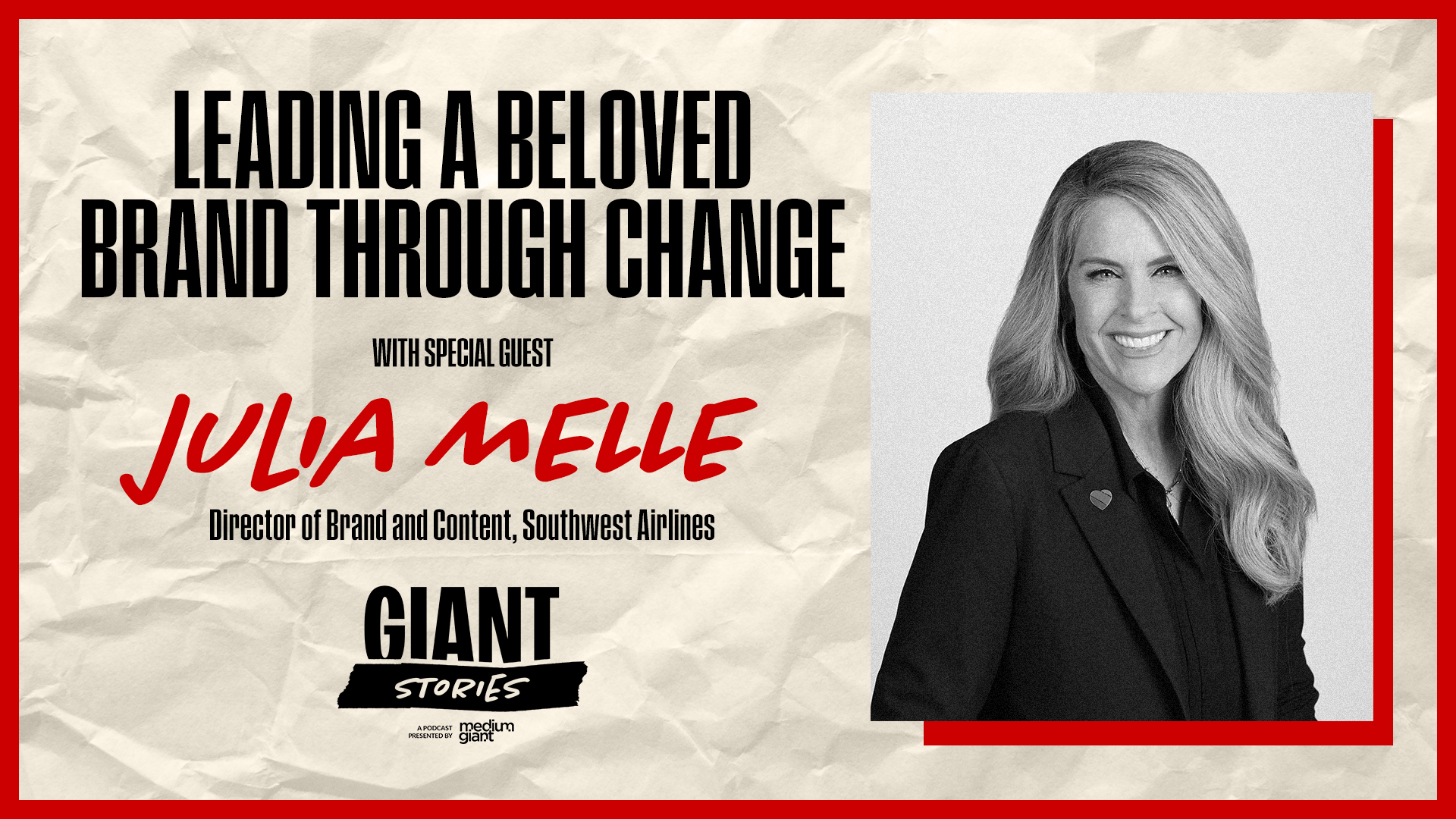
Episode 17 Transcript
[00:00:00] Welcome to Giant Stories, a podcast inspired by people and brands with meaningful stories to share. I’m John Kiker, your host and president of Medium Giant, a fully integrated creative agency in Dallas, Texas. Today, I am thrilled to welcome a friend and a well-known creative and brand leader around this, around this town.
Uh, Julia Melly. She’s the director of brand branded content at Southwest Airlines, where she’s leading one of America’s most beloved brands through, I would say, quite a transformative chapter, uh, in its history. To put it mildly. Uh, but Julie’s path to, to Southwest is, is an exercise in, uh, career creative range, shall we say.
She spent nine years at Leo Burnett and LB works in Chicago, working on campaigns like p g’s always and Kellogg’s Special K uh, breaking records or picking up some hardware, um, you know, a can gold line and gold Effie, just, just to name a few. From there, she served as executive creative director of Publicis and also as Creative Group head at the Richard Group.
Working on great brands like Alpha Romeo, Bridgestone, Dave’s Killer Bread, and, uh, Nestle Pure Life. How am I doing so far? You’re doing, you’re doing [00:01:00] well. You feeling good about yourself? All right, excellent. That’s my point, is to embarrass you a little bit. Uh, now at Southwest, Julie is doing something really rare, using decades of agency side creative fire power to lead a brand from the inside.
So from things like launching Shopify, which I want to talk a lot more about, the first of its kind, uh, commerce partnership. With, uh, TikTok that turn content creators into travel agents. Fascinating. Also, guiding Southwest through this just minor, minor seismic change like, uh, assigned seating that just launched this year.
Um, Julia is proving that an in-house creative can be, uh, the most powerful marketing tool that a brand has a writer by trade and artist by passion. She brings storytelling instincts that are as sharp as her strategic ones. And she’s built a creative team at Southwest that’s setting the standard for what in-house brand leadership can look like.
Julia, thank you for joining us on this fine Friday morning. Thank you for having me. Appreciate it. Absolutely bright and early. You know, some people need coffee. We’re just gonna do a podcast. That’s how we’re gonna wake up today. That’s right. That’s a good starter. I love to start these conversations by asking our guests to sort of give their story, and I kind of gave a, a couple of [00:02:00] highlights for you, but, um, you know, your journey is, is has been one that’s crossed the country and, and been to, been to some pretty amazing agencies and done some pretty incredible things.
So I would love for you to share with your guests. You bet. Um, my story started in Ohio. I’m an Ohio girl, uh, a small town in southwest Ohio, raised by, uh, a mayor. The, my dad was the mayor of Troy, Ohio, and my mom was a nurse, so I, I feel lucky to have. Been raised by some pretty great mentors in my life, um, and started in an in-house advertising agency, uh, in Ohio, a small retail, uh, department where I really, you know.
Learned the art of copywriting. Uh, I was an artist by trade, but I kind of transitioned into copywriting, so I started there. Okay. Which is great because you get to dabble, wear all kinds of hats, you know, pr, internal comms, um, advertising. And then from there I moved to Dallas, um, and started working for Tmin McClain at the time.
Way back in the day for those of us who remember. That’s right, that’s right. Oh, wow.
[00:03:00] American Airlines in Las Colinas. Yes. Yep. Exactly. And so I, I started in the loyalty department working on American Airlines. Okay. Yeah. Writing some of the loyalty newsletters for American. And I remember writing for the very first website.
Yeah. Which takes me back. Yes. Uh, and then from there, so I spent about three years there. And somewhere in my career, someone, and I don’t know who it was, but whoever you are, thank you, uh, told me to diversify myself as much as possible. And I started to think about it and I said, okay, Sage advice. Yes, Sage advice.
You know, at that point you can be truly valuable to your clients and offer a well-rounded perspective. So I thought, okay. I, uh, from there, went to a division of Ogilvy in Minneapolis, uh, and worked on some more. I launched a Starwood Preferred guest. Okay. So a little bit more loyalty, and then, uh, moved to Chicago and started with a boutique division of Leo Burnett focusing on tech startups.
Okay. So that was interesting during the tech boom. And then [00:04:00] from there, moved on to LB Works. Uh, another boutique division of Leo Burnett focused on passion brands. Okay. And it was there, uh, it was led by Jeff Jones and Stefan Paster. Mm-hmm. Um, and Jeff has gone on to, to lead an amazing career. Um. You know, target and HR Block most recently, and Stefan, you know, notorious for Altoids, uh, curiously strong.
So anyway, we built this, or they built, I should say this boutique division, um, focused on all these passion brands. But what it was is a unique business model where all disciplines were sitting together. So we were able to solve problems quickly. We were nimble. Um. Really focused, again with a focus on passion brands.
And what happened is our winning percentage in terms of new business was far greater than Burnett Proper at the time. So they were like, Hey guys, you’ve had your fun. Let’s fold you into the mothership. Lift and shift. Yeah, yeah, yeah, exactly. So then, [00:05:00] uh, then I was in the mothership and, uh, worked on some amazing.
Uh, brands such as Special K and, uh, always, you know, with p and g and got some amazing learning experience on building brands. Um, not just domestically, but globally. Uh, so I did that for, for many years. And then, uh, yeah, my husband found a job back here in Dallas, so, uh, we ended up moving back to Dallas. I then, I commuted to Chicago for two and a half years, uh, every single week.
Been there, done that. Yeah, it’s a lot. Yeah. You know. You are an exec pla and, and it’s cool for a while, and then you’re like, wow, I, you know, spending more time on a plane. So then at that point I transitioned to publicist, which is, you know, owns Leo Burnett. So that was an easy transition. Yeah. And ended up working my way up in that office to be executive creative director there.
And then went to the Richards group after that and, uh, and built a large group within the Richards group working on, uh, a lot of Charles Schwab and, uh, flowers Foods business. Mm-hmm. So a lot of CPG [00:06:00] Yep. As well. Um, and then, uh, yeah, and then started to kind of really think what I wanted to do in my career.
Um, you know, the Richards group was going through some transition itself at the time and indeed. And so I stayed there about a. You know, um, a year after some of that turmoil and then, um, started interviewing around the country thinking, what do I really wanna do? Uh, and that was an exciting time in my career, just talking to a lot of different people.
And, and that’s when I first started to consider going in-house. Um, and yeah, and then the position at Southwest popped up. And so it was a bit serendipitous and just. I was lucky enough to jump on that. Talk about a passion brand. Yeah, exactly. And I think that’s, to me, if I was gonna go in-house, I, I wanted to, to, uh, you know, work for a brand that was beloved and that it would be an honor to take care of and Yeah.
Um, that I believed in, but also one that I felt like I could. You know, uh, make a difference. And at the time, [00:07:00] Southwest had known for its swagger and strong personality and amazing work over the years, um, had kind of lost its way, it had become a more rational voice. Mm-hmm. And that was during the pandemic.
Mm-hmm. Uh, and that was at a time where a lot of new flyers were coming into the brand and the entire category was shifting in terms of behavior. Right. And so everybody was playing it a little bit safe. Yeah. And which may be fine for some brands, but for a brand that’s known for its personality, um, they had sort of lost their way.
And so people coming into the brand that were new didn’t really get to know the new, the southwest that Right. You know, uh, a legacy of freedom and right. And, and swagger. So, so I felt like I could bring that integrated experience, that diversified experience, um, in and, and help that personality come back a bit.
So, so. Talk about that because, you know, the, the legacy of Herb Kelleher obviously looms large over that organization and, and has permeated that culture forever. And so how do you, how do you hold on to those things like that sense of [00:08:00] independence, A little bit of sense of maverick, a little bit of smart ass, a little bit of, uh, take what they do seriously, don’t take themselves too seriously into the modern day where it’s so competitive.
And to your point, you have a lot of different players in the space now and the, the whole. Nature of air travel has changed, and obviously the company made a, a, a massive decision last year to, to move into assigned seating. So how do you not lose that spirit that’s always made Southwest unique and endearing, whether it’s internally from a cultural perspective, um, for, for everybody who’s worked there, they’ll tell you that culture is, is like nowhere else that they’ve ever been.
But also to make sure that it cascades out to the people who have been Southwest loyalists for decades upon decades and not lose that sense. Yeah. Well, that’s a huge question. Yeah. It’s, um, and I would have to say it’s a bit art and science. Yeah. I think that when you walk in our building, there’s a giant picture of Herb and, and you, you learn the culture and it’s an important part, you know, it’s an honor for me to take care of it every single day and make sure that [00:09:00] it, it, we don’t lose it.
And everybody feels that right. And so I think that when it’s, it’s a responsibility, right? It is a responsibility. It is. And I, you know, when you’re building a brand as you know, it’s, you’re building the brand architecture, it’s science that goes into it. It’s not just frivolous art and we’ll, we’ll, you know, make people smile.
You have to build that architecture that ensures that you do have brand consistency as you cascade it out. So, you know, our tone of voice, um, our positioning. Um, you know, has been relatively the same over the years. You know, we’re mm-hmm. We stood for this democracy of, of flight, um, you know, making it, it affordable, uh, for many, um.
And bringing that joy. There’s always been the undercurrent of people. Mm-hmm. Um, at that make Southwest difference, you know, um, friendly. The, the humanity has always been front and center. That’s right. Friendly, fun, easy. Yeah. Um, and those are core tenets of, of who we are and who we will always be.
[00:10:00] Um, so it’s making sure that those core tenants and that personality and that tone are built into that brand architecture.
Right. Even if the positioning ever so slightly changes. To make sure that, um, you still feel true and authentic to, to your customers. I think, like I said, the category has shifted a bit, um, and travel behavior has changed and so we’ve had to really consider that. Right. And listen to what, to what our customers want.
Um, the open seating has, has been a big part of, of who we are. I think there sometimes as a brand, you know, you, you think that a policy. Uh, or an RTB make sure brand, but it’s gotta be more than that. Sure. Because those things change over time. Well, it’s the why behind the RTB. Right? What’s the, what’s the motivation driving whatever policy or ritual that any brand wants to deliver to their customers, right?
That’s right. And in our. Purpose is to connect people to what’s important in their lives. Right. And we do that, you know, with fun, easy, friendly, reliable service, and award-winning [00:11:00] service, quite honestly. So those are the core tenets and that they forever will be. And what I, I’ve been using this analogy a lot right now because a lot of people are saying, who does, who is Southwest?
Mm-hmm. And are you the same as everyone else? And I always say, well, just because there’s two red apples on the table doesn’t mean they taste the same. Mm-hmm. You know, our people in our hospitality in that award-winning service. Will and forever always be our differentiator. So, you know, now as things change and policies change, and we must also change to be competitive and to be able to offer our customers more of what they’re wanting these days, right.
You know, there’s a lot of, there are a lot of flyers who, as an example. Want assigned seating because it brings more control to their life. Mm-hmm. It allows families to sit together. Mm-hmm. And so that’s something that we wanted to be able to offer our prospects and grow our audience and cast the net at wider and pull people into this amazing brand and let them experience this, this award-winning customer service.
So, um, so we’ve had to shift. [00:12:00] Um, to be competitive. Um, we are growing, we’re, we’re trying to listen to what our customers want, offering more destinations and the assigned seating then allows us to offer more fair products. Mm-hmm. Um, we now have extra leg room seating. Um, and that was fun. So we got to, my team, got to design those seats.
That’s fun. So when you’re, when you are in charge of the brand, you, you, it, you get the design. It’s everything. And a seat. Well, it’s cabin design, our new revamped cabins. Yeah, we did all of it. So picking the carpet, designing the seats, the new little embroidered hearts on the back of, of the headrest.
That’s fun. Um, picking the fabrics, all of it. It’s been the bulkhead, all of it. It’s, it’s been a lot of fun. But making sure that, um. You know, we are bringing that elevated experience to the customer mm-hmm. And what they want, um, more choice, um, when they travel with us and as we continue to grow, but never losing sight of who we are.
So it, it’s funny, I, I remember seeing the first, um, commercial probably last fall when you guys had announced a signed seating. Mm-hmm.
[00:13:00] And, uh, I, I think this was kind of like when there was mayhem in a mall and mayhem and anybody had heard about it and just like it was all. So I thought that was a really fun nod to like, this is the Southwest spirit.
Like again, it’s a big deal that we’re doing this, but like, again, we don’t take ourselves extremely seriously. And so this is a fun way to talk about something that we know that, that you guys knew was gonna be a seismic change. But how do you sort of embrace that big, you know, the, the, the. The gravity that it’s gonna, that, that it’s gonna have with some people.
That was a lot of fun. Yeah. That was a big discussion point at, you know, how do we announce what is essentially the most boring news ever? Right. Because it’s a, it’s a category norm, um, but it’s so disruptive to who your brand is. Yeah, historically. So I, I just thought that was a really fun way to, to, to think it, to, to think about how you communicate that.
Yeah. I think we decided Okay. Humor and a sense of humility is really the only way to go with it. So, which is who you are exaggerating. Yeah, exactly. We, we exaggerated the point. Yeah. And at the end, which is my favorite little moment and he’s like, you know, where you have this humble little moment with the two guys at the bar.
Yeah. Which hearkens back [00:14:00] to Herb and our cocktail napkin and where our whole, you know, everything was born on the, the cocktail napkin. So, um. Where they’re like, isn’t everybody, isn’t somebody else already doing this? Or hasn’t someone already else thought of this? And the other guy’s like, Hmm. And then it’s a hard cut out.
Yeah. Which adds to the humor of it. Yeah. So, um, so yeah, so that was a lot of fun to, to come up with that. And then at the time we had the sister spot to it, which is, we’re called, we call Boarding Royale, which is the Hunger Games esque spot that we came up with. And that was never intended to be a Super Bowl commercial.
It was just meant to be the sister spot to Are you sitting down? And we thought, wow, this would. Be a great Super Bowl commercial and also we thought it would be great to launch it at the time Super Bowl being right around when we were changing over to assigned seating. So we thought, okay, perfect time to sort of close that chapter and start, start chapter two.
That’s fun. Yeah, I love that. So you come into Southwest working with some great brands and, and understanding, you know, how to. How to communicate what’s most [00:15:00] meaningful about these brands from a, from a storytelling perspective. But I want to go back to, to what you had said about the, the start of your career, working on a lot, on the loyalty side.
What did you carry over from that into bigger brand work that you, that you eventually got into? ’cause it’s usually, you know, that you, you don’t see people move sort of from that sort of a niche style of, of, of, of the business into. Into broader brand stuff. That’s a great question, and no one’s ever asked me that before.
I appreciate that. I think when you work in loyalty marketing, you, it’s all about building those highly valuable, meaningful conversations with your customers. Mm-hmm. And getting to know them on and a more intimate level and what matters to them. Um, and all the different tiers within loyalty. Right. Which, you know, there’s a lot of, you know, different rewards at different levels.
You know, they’re at a different part of their journey. Mm-hmm. Um, with your brand, so. Um, so you have to learn in how to vary the conversation and develop how to, you know, build those meaningful conversations [00:16:00] with different, uh, variances of your target audience, right? So, you know, you’re doing a lot at the time, getting into a lot of variable data, um, to build those meaningful conversations.
And so, uh, I think that has. Was a great learning ground for me coming into even just mainstream. Where you’re building much broader target audience is you still have to do that versioning to make sure you’re hitting them with the RTBs that matter to them, right? To build those meaningful conversations.
And, and knowing where your customers are in their journey with you, um, you know, is important. So I, you know, I’m probably a rare creative in where I, I do believe in the data informing what your customers want and what’s important to them, so that you can cater those conversations, probably helps you understand, you know.
I think a lot of creatives who have spent most of their careers specifically on brands, view insights in a very different way. Mm-hmm. It’s more, I mean, obviously the, the, the point of an insight is to spark a creative solution that’s gonna, you know, solve the problem in a unique way that’s gonna connect.
But I would think getting that far into the data on the loyalty [00:17:00] side, like really it helps you understand insights from a, from a more, um, dispassionately quantitative perspective, uh, to understand how, how do you get to something. Right? Right. It does, and, and. As much as I love quantitative data and ’cause it, it doesn’t lie, you know?
Right. You can’t, you can’t hide from it. I do love qual. Mm-hmm. Um, I love ethnographies. I love really getting in with the customer and asking questions and listening loudly to what they’re saying. Uh, ’cause sometimes I think you can find hi hidden nuggets of truth. Uh, in those conversations, I think the quantitative oftentimes reveals opportunities to, to, to your point, to dive into the qual.
Like, okay, yep. Why are the numbers the way they are? Like, let’s understand what’s going on in the nuances. And that’s where those conversations can sort of un unearth something that kind of, you know, gives you that aha. That’s right. I think one thing that’s been humbling for me in my career is it’s never.
As intuitive as you may think it is, you know, you think you, you can rely on gut instinct and a lot of time you can and, and your perspective and your, your [00:18:00] experience, but the data does reveal the truth and it does sort of, um, teach you that you, you know, while intuition is important and gut is important, yeah.
Uh, you gotta listen to, to what your customers are telling you. Yeah. So I think the, this is just my perspective, but I’m sure you, you can relate so across our careers. I think the biggest change, um, in our business, obviously it’s not just the channels through which we communicate, it’s the proliferation of content that’s out there that, that we have to be able to produce.
I mean, you used to be able to think, let’s take Southwest, like, okay, really solid billboard campaign. Pretty simple print stuff, meaningful tv, uh, radio on occasion, and off you go. Right? And so now you guys have to think, you know, it’s, you know, take a assigned seating as, as the, as the, uh, recent example.
How do you guys think through content? Creation and, and curation and proliferation, knowing that there’s so many places that you have to be now, um, beyond the screen, whether it’s digital, whether it’s social, whether it’s all these [00:19:00] channels. Like how do you guys view storytelling in a, in a, in a way now that has to serve so many channels in so many, so many different audiences.
Yeah, I think it used to be, it was very different where. Everything sort of had to match. Yeah. And I think now it’s important that there’s just a universal strategy that carries everything that permeates throughout all your work. Right? So, so that’s the constant, but really understanding the media is the message.
So understanding all of your channels and how you have to diversify your strategy to so that it feels organic to those channels. Right. So I think we’d like to think about it as. A universal strategy, but make sure that we’re organic to the channels that we, we reach our customers in. So it feels authentic to that.
Yeah. So how do you think about, um, content creation? Mm-hmm. In terms of like how much you have to create now versus 10 years ago, or heck, even five years ago, in terms of like the, the, the, the volume of production and all, all the places that you have to [00:20:00] be, obviously AI plays into it to some degree, but how are you guys, how are you guys thinking about that?
Well, you know, back to building those meaningful conversations, right, to the different customer segments and wherever they are happen to be in our, in their journey with us, I think, you know, it’s thinking about how to scale the message faster, right? Um, so we’re obviously starting to, to lean into that and explore, you know, use technology to our advantage there.
Um, but. You know, we’re still, we’re growing, um, and learning and, and, you know, meeting new partners that can help us do that on, on a daily basis. But I dunno if I answered your question. You did. No, I, it just, um, you know, you talk to some, to some brands who, you know, who are working with the, the Adobes of the world or mm-hmm.
Whomever to understand like, okay, how can I create one thing and. Produce 30 different versions of it, um, at the snap of a finger with Yeah. You know, whether it’s changing the color of a car or whatever it might be to match a particular person’s interest and all that kind of thing. Yeah. We’re [00:21:00] working, we work closely with Adobe.
Okay. And, um, you know what we’re really taking a hard look at now is our a, um. Uh, and you know, you’re only as good as the health of your assets. Yes. Really, when it starts to scale. Yep. So really taking a look there, I remember, I think it was maybe my first week in and I noticed we put an ad out there, um, promoting a particular destination.
And I think all it was us, American, and United all had the same image the same day in the content. And I was like, okay guys, we gotta take a look at our assets and where are we pulling this from. Exactly. And I think a big. You know, we have a lot of assets across our organization and you know, we have our comms department that has some, that does some great storytelling, right.
And, and is sitting on some, some amazing assets and, and then our department brand and, um, innovation team and all over. So it’s, it’s really aggregating mm-hmm. All of that. And, you know, coming up with a tagging system and figuring out where your gaps are. Um. And we’re really taking a hard look at all of that [00:22:00] right now as we begin to scale, to make sure that the health of our data and our assets is, is there and in a good place.
So we’re looking at all that, you know, right now, actually as we speak, and to make sure that we can scale faster. That’s the amount I think of, of between the data and the assets. And again, like how do you tag it? How do you deploy it, how do you manage it, how do you go? The governance that you have to have in place is, is pretty insane.
Yeah, I would imagine. Um, so. Talk about storytelling. Um, has it, has it evolved really well? I think that with all the different channels and the ways to tell stories, you have to think about all the different, you know, storytelling lengths. Yeah. Just to, you know, you have, um, long format, short format. A lot of sixes now.
Yeah. You know, that, that you’re creating. Um, and you like to think about it. So there’s story within a story within your channel, but it’s the story that you’re creating as a brand, right. Holistically [00:23:00] across all of your media channels too. So I like to think about it both ways, um, but fundamentally like has like a story really changed, like there.
There’s a hook, there’s a climax, there’s a payoff, right? That’s right. I mean, yeah. You know, even you, you analyze all the, the Superbowl work, right? And there’s always, you know, a protagonist and, um, there’s a theme and you look in, in a lot. It’s over the years, it’s a lot of the same storytelling basics and fundamentals.
Like you said, you got your protagonist, you got your theme right? You got your arc, um, your climax, and then they, you land the plane, so to speak. So yeah, I think sometimes people get lost in, in. Maybe the perception that, um, whether it’s technology or celebrity can sort of be the story into themselves. And it’s like, no, they’re actually helping to fill a narrative that should already sort of fit what that brand is.
And so like for, obviously for Southwest, you know, the narrative is, is democratized travel. We connect you to, to, to, to your, to your point, to the, to the people and places that they care about. [00:24:00] Mm-hmm. Um. Talk about some of your other experience on, on other great brands that, that, that had really meaningful stories to, to, to share.
Hmm. Uh, let’s see here. I’m trying to think of some of the, I mean, I’ve been lucky to work on a lot of different brands, um, with some great storytelling. I think, um, you know, if I go back to my, even my p and g days mm-hmm. And think about that target audience mm-hmm. For always. Mm-hmm. Um. I fell in love with that target and it wasn’t exactly me, you know, um, you learn that there’s a lot of women out in the world that are, we learned through the data that predominantly that target audience were women that, uh, were trying to make a difference in the world.
A lot of customer service positions, um, community service, right. And uh, just. What embracing their, uh, female. And so there were some great storytelling there and just, um, that has led to some [00:25:00] great work on that brand. Um, we started with have a Happy period and mm-hmm. Um, some of the greatest storytelling started.
Uh, we realized through our PR team that there were little girls. In Africa who didn’t have proper protection. Mm-hmm. And nor did their schools have bathrooms. And we realized what was happening is they were dropping outta school because they had to miss um Oh wow. School during their cycle, and therefore it was changing the trajectory of their society because all these girls were dropping outta school.
And so we realized that, and we felt like, okay, that’s our story to tell the world. Um, that this is happening, right? And we knew that women are like, you know, it takes a village to raise a child. So we offered a discount on our product when you bought it to, that would go toward funding these building bathrooms in these schools.
And we did it. Um. And it, it changed the society. So we were really proud of that. So that’s where I love it in our industry where storytelling can make a difference. You know, I look back and there’s a lot of amazing, you know, super Bowl [00:26:00] commercials and I sure did an Alpha Romeo Super Bowl commercial telling the story of that car and that, that was a lot of fun.
But I do love it when it can make a difference in people’s lives and that that was a great opportunity. I think for Special K. It’s about, you know, women that are on this journey to a healthier. You, um, the, the story, uh, and how our product plays a role in, in their lives, right? Um, uh, and you know, and again, it’s like we realized a lot of women wanted some chocolate at nine o’clock at night, so we came out with a product that, that, uh, sufficed them in that moment and, and telling that story and so, you know, and then, then all their health stories and allowing them to connect with one, one another and, and building that bridge there to, to facilitate conversation between women.
I, whenever I go talk to college students about, you know, who, who are advertising majors and, you know, after I try and, you know, scare ’em a little bit and make sure that they’re really in, on this thing, you know, you, that I think there’s a lot of questions like, why would I want to get into this business [00:27:00] now?
You know, what is it about advertising and story? You know, the, the examples that you’re giving that you actually can make a difference and, and that there are, there are things that you can do on behalf of brands that serve a commercial purpose. Um, ’cause that’s what brands are paying you to do, but also have, have the opportunity to, to make substantive change.
And whether it’s on a very micro scale or a macro scale, I think, um, this is a generation, um, coming outta college that does wanna make a difference, that do that, that have seen, uh, you know, the, uh, the, perhaps some of the positives and some of the missteps that us Gen Xers have, uh, have, have gone through.
So I, I think it’s important that, that, that we impart on, on them, you know, that. Not only do you have the opportunity to make a difference, but the tools that you have now to do it with and and the channels that you work Yeah. And where you can show up are, are so different than, than they were when we were coming out.
That’s right. And I think that that’s what’s so great about working on Southwest mm-hmm. Is here you’re sitting on a category and for a brand that believes in connecting you to people in places that matter most. Right. So, you know, and all the opportunities that opens by, by [00:28:00] inspiring travel. Right. You know, and, and so that’s a wonderful.
You know, thing to believe in every day when you get up in the morning is that you’re, you’re building these bridges to, you know, broader connections to the world. Yeah. And so, so that’s a lot of, lot of fun. And it’s, and it’s easy to get people rallied around that. Yeah. At work. How, how do you guys think about, um.
From a, from a creative perspective, ’cause AI has a, has a million different places and uses. Mm-hmm. But how are you guys thinking about AI from a creative perspective? Well, I think it, from a creative perspective Yeah. Because it kind of depends who you talk to, right. And I think, um, we’re thinking about it in a couple different ways.
I think one as a tool of inspiration. Mm-hmm. You know, I think it can, you can plug in your hypothesis or, um, you know. You know, some copy and have it, you know, feedback, some different ideas, uh, you know, that may inspire your concept and Right. Um, so as a tool of inspiration, but also as a tool of efficiency.
Mm-hmm. You know, how can it help us, um, like I said before, scale right at the pace we need to scale. Um, you know, we learn about subject [00:29:00] lines quickly, um, in our emails. What works, what doesn’t work. AI helps us there. Yep. Um, so it can be a basic utility and then just a big broader utility to, you know, as we build this, this scalable platform.
So good. Um, so talk about storytelling and where it’s headed. Um, you know, you, you talk about the different formats and, and, and, you know, how are you guys at Southwest thinking about, you know, where the brand goes from a. From a storytelling perspective moving forward, like how, you know, where else, where else do you, do you start to show up maybe that you haven’t in the past?
Well, I think that, you know, as our product evolves, you know, I go back to my Apple analogy. Yeah. That I said before. I think that for us there’s nostalgia. Like we are going back to the root of our brand and not losing sight of that, which are our people. Mm-hmm. And all the way that they take care of our customers and the stories, [00:30:00] just the stories that come out of all those experiences just right themselves.
Yeah. You know what, what we do and what we’re committed to is embracing those stories and embracing our people and empowering them to take care of our customers and that hospitality that we believe differentiates us. And then those stories just write themselves, you know, all the, there was just a story this week about this little boy, uh, William.
And he is an aviation lover and Okay. Um, likes to see the cockpit on the plane and all that. Oh, he does? Yeah. And, and Bob, our CEO heard about it and so brought him, flew them into, uh, headquarters and let ’em fun, you know, experience the simulator and Very cool. You know, so, so telling William’s story as a five old and his love for flying and, and being a part of that story, you know.
I think it’s, it’s the role our, our brand plays in the story too. That is important. Absolutely. Not just putting our logo everywhere. No, but playing a true role, um, and facilitating, you know, connecting people to what matters most. So, [00:31:00] so there, you know, there’s new stories every day that come out. You know, our people returning items, um, driving people to where they need to go, you know, something happens.
And I mean, it’s just the, the stories are incredible. Well, and that’s the stuff that, that, that endures, right? I mean, that, that’s the, you know, that’s to, to your point, that’s always. You talk about nostalgia, which actually is, is kind of a trend in unto itself. If I mm-hmm. If I see another eighties, eighties theme show or anything like that, I’m gonna kind of lose my mind.
But, um, well, you know, why that’s happening. It’s a, it’s, it’s so interesting that even, you know, younger generations now, they are embracing it. Yeah. And you get into the psychoanalysis of it. Yeah. Because it brings a sense of. Um, solidarity to them and, and control and calm and it So ing Dad, you heard in Pesh mode?
Yes. Yes. You may have dressed up like the late singer once or twice, maybe back in the day. There is no photo evidence to document that though. So my, my kids will never Lucky for you. I know. Lucky for us. Social media didn’t exist. Oh my lord. On, on so many levels. Yes. It’s a, it’s a very good thing. It’s, but [00:32:00] uh, anyway, now Julie, this has been an awesome conversation.
I really appreciate you being here. Oh, it’s my pleasure. So much fun. Thank you.
Back to Top